BlackRock's Protected Bitcoin ETF (PBIT): Can UK Investors Buy It?
BlackRock has filed for a bitcoin ETF that trades some upside for a cushion against losses. It isn't approved yet, and UK retail investors are unlikely to get it on their platforms anyway. Here's how it works, why, and what UK investors can use instead.
By Sam Whitfield, Editor · Published · 7 min read
Probably not, at least not as an ordinary UK retail investor. On 19 October 2026 BlackRock filed with the US Securities and Exchange Commission for the iShares Bitcoin Managed Protect ETF, reported under the ticker PBIT. It aims to cushion some of bitcoin's falls in return for capping the gains. It isn't approved or trading yet. And even once it is, it'll be a US-listed fund, which most UK platforms don't offer to retail customers.
So the headline is American. The useful question for a UK reader is a different one: what does a "protected" bitcoin fund actually give up, and what can you realistically use here instead?
What is BlackRock's protected bitcoin ETF?
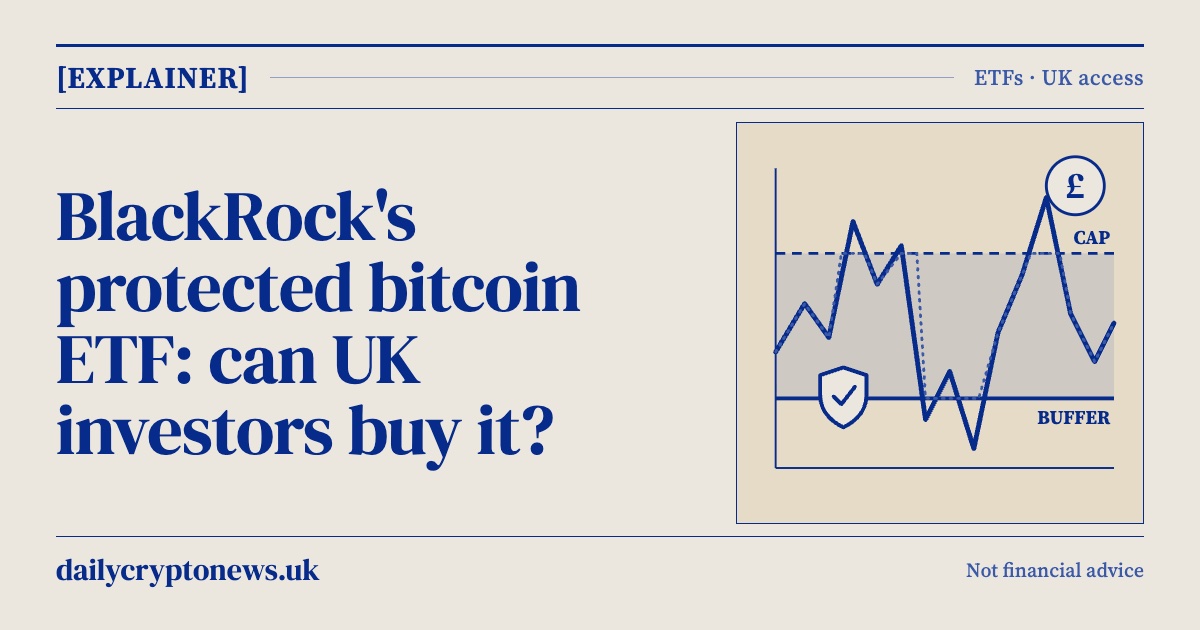
It's a proposed "buffer" fund built on BlackRock's existing iShares Bitcoin Trust (IBIT). According to the filing as reported by The Block, it seeks upside exposure to IBIT up to an approximate limit while providing some downside protection. Bitcoin Magazine reports it would use options and fixed-income holdings rather than holding bitcoin directly.
The mechanics are familiar from stock-market buffer funds. Most of the money sits in safe, interest-paying bonds. A slice goes into options linked to the underlying asset, here IBIT, the largest US spot bitcoin ETF with more than $65bn under management according to The Block. The options supply the upside. Selling other options pays for the protection, and that's where the cap comes from.
What we don't know yet matters more than what we do. The protection level, the cap and the fee were not disclosed in the filing coverage, per Yahoo Finance and CoinCentral. Those three numbers decide whether a product like this is any good, so anyone calling it a winner right now is guessing.
Why are people suddenly searching for it?
Because bitcoin has had a rough October and the idea of "bitcoin, but with a seatbelt" lands well after a fall. Google Trends showed "blackrock bitcoin downside protection fund" as a breakout search in the UK over the past week, and the filing was all over crypto X between 19 and 22 October.
Timing helps too. Bitcoin slipped below $82,000 on 22 October (we covered why crypto fell that week), and CoinDesk pointed out that a rival product from Calamos, which launched protected bitcoin ETFs in early 2025, was down only about 1% over a period in which bitcoin fell as much as 52% from its record high. That's a striking comparison. It's also a comparison taken at a flattering moment, which is worth remembering.
Can UK investors buy US bitcoin ETFs like PBIT?
Generally, no, if you're a retail customer on a UK platform. US-domiciled ETFs usually don't produce the UK-style key information document that UK firms need before selling packaged products to retail investors, so most UK brokers simply don't list them for ordinary accounts. Check your own platform, but don't expect PBIT to appear.
Two other UK rules sit in the background:
- The FCA's crypto ETN opening is narrow. Since 8 October 2025 UK retail investors can buy crypto exchange-traded notes, but the FCA says they must be traded on an FCA-approved, UK-based exchange. A US-listed fund doesn't fit that route.
- The FCA's retail ban on crypto derivatives is still in place, as the regulator's own announcement confirmed. That's relevant because the obvious "build your own buffer" approach, buying and selling bitcoin options, isn't something UK firms can sell you as a retail client.
What about the disclosure rules changing? The FCA's new Consumer Composite Investments regime replaces the old PRIIPs key information document with a simpler product summary. According to Freshfields' summary of the final rules, firms could start using it from 6 April 2026, and it becomes mandatory on 8 June 2027. That may lower one barrier over time. Nothing in it promises that US ETFs will turn up on UK platforms, though, and I wouldn't plan around it.
What's the catch with buffer funds?
You pay for protection with lost upside, and the protection only works on the fund's terms. Buffer funds are measured over a set outcome period, often a year. Buy halfway through, especially after a rally, and you may get less upside and less cushion than the headline suggests, Yahoo Finance notes. Losses beyond the buffer are yours.
The trade-offs in plain terms:
| Feature | Plain bitcoin ETP | Buffer-style bitcoin fund |
|---|---|---|
| Upside if bitcoin doubles | Full (minus fees) | Capped at the fund's limit |
| Downside in a crash | Full | Reduced, within the buffer only |
| Fees | Typically low | Generally higher than plain ETFs |
| Timing matters? | No | Yes, results depend on the outcome period |
| Available to UK retail? | Yes, UK-listed ETNs/ETPs | Not on most UK platforms |
Here's the bit people skip. Bitcoin's long-run appeal, for those who hold it, has been the occasional huge year. A cap trims exactly those years. If bitcoin rose 80% in a year and the cap were set at, say, 15% (a made-up number, as PBIT's isn't known), you'd keep 15%. That's the price of sleeping better, and for some people it's a fair price. For others it defeats the point of owning bitcoin at all.
My take: buffer funds are a sensible product for nervous money, but "protected bitcoin" is a slightly misleading phrase. You're buying a bond-and-options package with a bitcoin flavour, and you should judge it like one.
What can UK investors use instead?
There's no like-for-like product on UK retail platforms, but you can get close to the same shape yourself. The straightforward route is to cap how much you can lose by capping how much you put in: keep most of the money in cash or gilts, and put a small, fixed slice into a UK-listed bitcoin ETP such as BlackRock's own iShares Bitcoin ETP (ticker IB1T), which launched on the London Stock Exchange on 20 October 2025.
A rough worked example, not a recommendation:
- £10,000 to invest.
- £9,000 in an easy-access or fixed-rate savings account (FSCS-protected up to £120,000 per person, per banking licence).
- £1,000 in a UK-listed bitcoin ETP.
If bitcoin went to zero, your worst case is losing £1,000 minus the interest earned on the £9,000. If bitcoin doubled, you'd make about £1,000 on that slice, with no cap. It's cruder than an options-based fund, and you have to rebalance it yourself, but it's transparent and you can do it today. (Bear in mind that crypto ETNs don't get FSCS protection, as the FCA spells out.)
For more on how the UK-listed route works, see our guide to UK bitcoin ETPs on the LSE and our piece on crypto risk management.
How would a US fund be taxed if you held one?
Badly, potentially. A fund based outside the UK is an "offshore fund" for HMRC, and the tax depends on whether it has UK reporting fund status. Gains on a reporting fund are taxed as capital gains. Gains on a non-reporting fund are taxed as an offshore income gain at your highest marginal income tax rate, and capital losses can't be set against it, ICAEW explains.
This isn't theoretical. ICAEW reported on 12 October 2026 that HMRC has started writing to people who hold, or recently held, offshore fund investments, asking them to check they've reported income and gains correctly. HMRC describes the letters as educational rather than a compliance check.
So if you do get access to a US bitcoin fund some other way, for example through a professional-client account, check the exact share class on HMRC's approved offshore reporting funds list before you buy. Status can vary by share class and by period. UK-listed bitcoin ETNs are a different animal and follow the normal crypto capital gains tax rules, and our crypto ETN and ISA guide covers the wrapper question.
Frequently asked questions
What is the BlackRock bitcoin downside protection fund? It's the iShares Bitcoin Managed Protect ETF, reported under the ticker PBIT, which BlackRock filed with the SEC on 19 October 2026. It aims to give upside exposure to its IBIT bitcoin fund up to a limit, while cushioning some losses. It isn't approved or trading yet, and its cap, protection level and fee weren't disclosed.
Can I buy PBIT on a UK investment platform? Very unlikely as a retail investor. Most UK platforms don't offer US-domiciled ETFs to retail customers because those funds usually lack the UK-required key information document. The FCA's October 2025 change only opened UK retail access to crypto ETNs traded on UK-based, FCA-approved exchanges.
Is there a UK version of a protected bitcoin ETF? Not on mainstream UK retail platforms as of 27 October 2026. UK investors can buy plain UK-listed bitcoin ETPs, such as iShares Bitcoin ETP (IB1T) on the London Stock Exchange, and limit risk by keeping that holding small relative to cash or other assets.
Does a buffer ETF mean I can't lose money? No. A buffer only covers losses within its stated range over a set outcome period. Losses beyond the buffer fall on you, results differ if you buy or sell mid-period, and fees are usually higher than a plain ETF. The trade-off is a cap on your gains.
How are US funds taxed for UK residents? They're offshore funds. If the share class has HMRC reporting fund status, gains are capital gains. If not, gains are taxed as offshore income gains at your highest income tax rate, and capital losses can't offset them. Check HMRC's approved reporting funds list by ISIN before buying.
The practical next step
If the PBIT news has you thinking about bitcoin with a safety net, start with the part you control: decide the most you're prepared to lose, and size any bitcoin holding to that number. A UK-listed ETP inside that limit gets you most of the way there without waiting for a US product that may never reach your platform. This is general information, not personal financial advice. If you're unsure, speak to a regulated financial adviser.
Sources
- The Block: BlackRock files for bitcoin ETF offering downside protection and upside exposure to IBIT (19 Oct 2026)
- CoinDesk: BlackRock seeks to shield bitcoin investors from losses after Calamos fund weathers 50% crash (20 Oct 2026)
- Bitcoin Magazine: BlackRock files for bitcoin ETF with downside buffer and capped upside
- Yahoo Finance: BlackRock wants to launch a bitcoin fund that limits your losses. What's the catch?
- FCA: FCA opens retail access to crypto ETNs
- Freshfields: FCA publishes its final rules for Consumer Composite Investments
- ICAEW: HMRC contacts UK investors in offshore funds (12 Oct 2026)
- GOV.UK: Approved offshore reporting funds
- FXStreet: BlackRock launches iShares Bitcoin ETP for UK retail investors (20 Oct 2025)
Sam Whitfield
Sam Whitfield is the pen name of the editor of Daily Crypto News UK, who writes and reviews every article on the site.