Over $1bn Liquidated as Bitcoin Fell Below $76,000: What Crypto Liquidations Are, and Can UK Traders Use Leverage?
Bitcoin dropped about 6% on 5 November and more than $1bn of leveraged bets were forcibly closed. Here's how a liquidation works, how small a fall it takes at 10x or 50x, and why UK firms can't sell you crypto futures in the first place.
By Sam Whitfield, Editor · Published · 9 min read
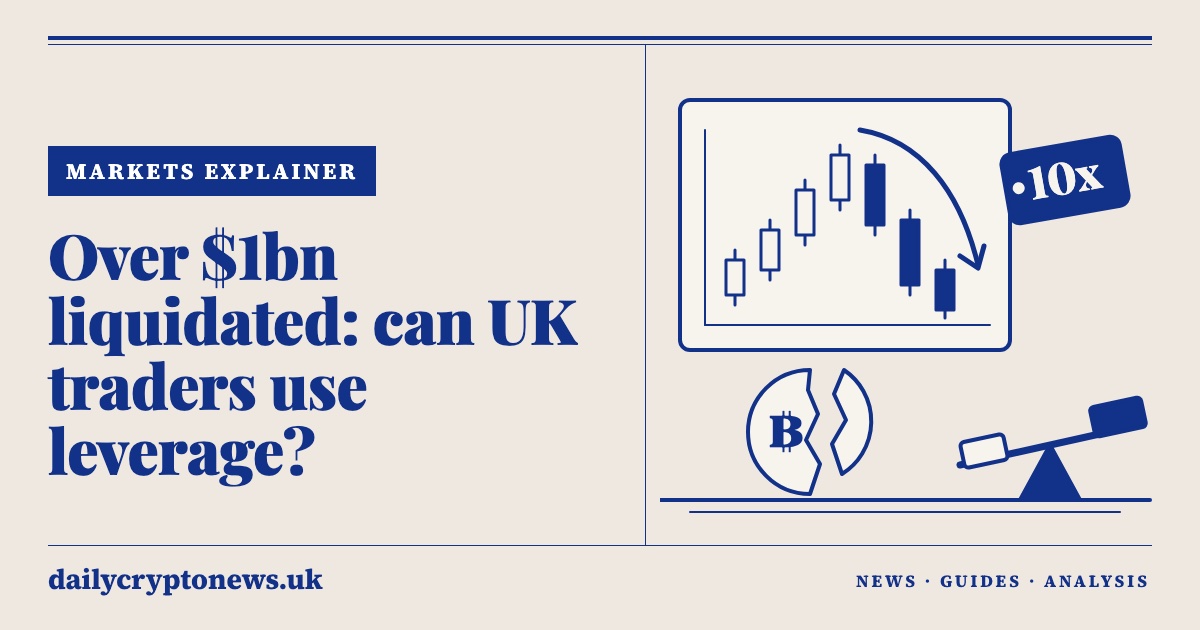
A crypto liquidation is when an exchange forcibly closes a leveraged trade because the trader's deposit can no longer cover the losses. On Thursday, 5 November, Bitcoin fell about 6% to roughly $75,700, about £56,300, and more than $1bn of those positions were wiped out in 24 hours. Most UK retail investors weren't among them, because UK firms have been banned from selling them crypto futures since January 2021.
That last part surprises people. So here's what actually happened on Thursday, how a liquidation works with real numbers, and where UK rules leave you if you've been tempted by a "100x" button on some app.
What happened to Bitcoin on 5 November?
Bitcoin gave back its post-election gains on Thursday, falling about 6% to around $75,700 (roughly £56,300) after a sharp sell-off in US tech and AI stocks. It had been above $80,000 the day before. Ether fell more than 7% to $2,247, or about £1,670, and leveraged traders who'd bet on a rise took the hit.
The numbers come from The Block's report, which used CoinGlass data. A few of them are worth pausing on:
- In just four hours, about $879.9m of positions were liquidated. Of that, $818.9m were longs (bets on prices rising) and only $61m were shorts.
- Over 24 hours the total was close to $1.1bn, spread across nearly 211,000 traders.
- The Nasdaq Composite was down 4.7% by 2pm New York time, and the VIX, Wall Street's "fear gauge", was up about 60%.
So roughly 93% of the money liquidated in that four-hour window came from people betting the rally would continue. That's the usual pattern when a market drops quickly after a run-up. Everyone piles in on the same side, and a fall knocks them over like a row of dominoes.
One caveat The Block flags itself: public liquidation figures may significantly understate the real total, because not every exchange reports every forced closure. Treat $1bn as a floor, not a precise count.
| Measure, 5 November 2026 | US dollars | Pounds (about $1.345 to £1) |
|---|---|---|
| Bitcoin, Wednesday high area | above $80,000 | above £59,400 |
| Bitcoin, Thursday low area | about $75,700 | about £56,300 |
| Ether, Thursday | $2,247 | about £1,670 |
| Liquidations, four hours | $879.9m | about £654m |
| Of which long positions | $818.9m | about £609m |
| Liquidations, 24 hours | nearly $1.1bn | about £810m |
What does "liquidated" actually mean in crypto?
Being liquidated means the exchange has closed your leveraged position for you, at a loss, because your margin (the deposit backing the trade) has fallen to the minimum it allows. It isn't a choice and it isn't a pause. The position is gone, the margin is usually gone with it, and a price recovery an hour later doesn't bring it back.
Leverage is borrowed exposure. Put down £1,000 at 10x and you control a £10,000 position. If Bitcoin rises 5%, you make £500, which is 50% on your money. Lovely. If it falls 5%, you lose £500, half your stake, and that's where it turns nasty.
Exchanges don't wait for you to lose everything before acting. Each one sets a "maintenance margin", a minimum cushion, and when your losses eat into it, the engine sells. That's why liquidations cluster: one forced sale pushes the price down a little, which triggers the next trader's liquidation price, which pushes it down again. Thursday's four-hour figure is that cascade in action.
There's a second sting most people miss. Fees, and on perpetual futures the regular "funding" payments, nibble at your margin while you wait, so you can get closed out a bit sooner than the headline maths suggests.
How big a price fall does it take to get liquidated?
Roughly 100% divided by your leverage, and in practice a little less. At 10x, a fall of about 10% wipes out your margin. At 20x it's about 5%, at 50x about 2% and at 100x about 1%. Thursday's 6% drop was more than enough to close anyone long at 20x or higher.
Here's the rough arithmetic for a long position with £1,000 of margin. It's illustrative: real liquidation prices depend on each exchange's maintenance margin, fees and funding, which all push the trigger a bit closer.
| Leverage | Position size on £1,000 | Fall that wipes out the margin (roughly) | Closed out by Thursday's ~6% drop? |
|---|---|---|---|
| None (spot) | £1,000 | Can't be liquidated | No: you'd be down about £60 on paper |
| 2x | £2,000 | about 50% | No |
| 5x | £5,000 | about 20% | No |
| 10x | £10,000 | about 10% | Probably not, but close to the line after fees |
| 20x | £20,000 | about 5% | Yes |
| 50x | £50,000 | about 2% | Yes |
| 100x | £100,000 | about 1% | Yes, long before the low |
Look at the top row for a second. Someone who simply owned £1,000 of Bitcoin on Thursday was down about £60 and still owns their coins. Someone at 20x with the same £1,000 has nothing left. Same market, same day. The only difference is the borrowed money.
Honestly, this is the part of crypto I'd most like beginners to understand before they touch it. Bitcoin moving 6% in a day isn't rare. Our explainer on why crypto fell in late October covered a similar slide only two weeks earlier. A strategy that can't survive an ordinary bad day isn't really a strategy.
Can UK retail investors trade crypto futures or use leverage?
Not through UK firms. Since 6 January 2021, the FCA has banned firms acting in or from the UK from selling, marketing or distributing crypto derivatives (futures, options and contracts for difference) to retail clients. When it confirmed in August 2025 that crypto ETNs would reopen to retail investors, it said in plain terms that the derivatives ban "will remain in place".
The FCA gave its reasons when it brought the ban in: crypto has no reliable basis for valuation, prices are extremely volatile, market abuse and financial crime are common, and retail investors don't have a legitimate investment need for these products. It estimated the ban could reduce harm to retail investors by somewhere between £19m and £101m a year.
It also said something you should remember the next time an advert offers you leverage: any firm offering these products to UK retail consumers is likely to be a scam.
That doesn't mean leveraged crypto trading is invisible in the UK. A few routes exist, and they're very different:
- Professional client status. The FCA's ban covers retail clients, so some regulated firms offer crypto derivatives only to clients they class as professional. Being treated as a professional client means giving up protections that retail clients get, so check with the firm exactly which ones before you opt up. The tests are designed to be hard to pass for an ordinary investor, and they should be.
- Offshore exchanges. The FCA's ban applies to firms, not to you personally. But an offshore platform selling futures to UK retail customers without permission is breaking UK rules, and you'll have little protection if it freezes withdrawals or collapses. Our piece on the £20m BitMEX claim looks at whether UK traders can ever undo losses on unauthorised platforms. It's a long, uncertain road.
- Apps and adverts promising 100x. Assume the worst. Check the firm on the FCA register yourself, using the FCA's own website rather than a link in the advert.
What can UK investors use instead of leveraged crypto?
Unleveraged products, mainly. You can buy crypto outright on an FCA-registered exchange, or, since 8 October 2025, buy crypto exchange traded notes (mostly tracking Bitcoin or Ether) listed on an FCA-approved UK exchange such as the London Stock Exchange. Neither can be liquidated in a sell-off, although both can still fall sharply and neither is covered by the FSCS.
 Photo: gren, public domain, via Wikimedia Commons
| Route | Leverage? | Can you be liquidated? | Main UK protection |
|---|---|---|---|
| Buying crypto on an FCA-registered exchange | No | No | Firm must be registered for anti-money-laundering; no FSCS cover |
| Crypto ETN on a UK exchange (from 8 Oct 2025) | No | No | FCA promotion rules and Consumer Duty; no FSCS cover |
| Crypto futures as a professional client | Yes | Yes | Some retail-client protections given up |
| Offshore exchange selling futures to UK retail | Yes | Yes | Very little in practice |
Crypto ETNs, by the way, are the reason the FCA had to restate its position on derivatives in 2025. People assumed that if notes were allowed, futures would follow. They didn't. Our guides to Bitcoin ETPs on the London Stock Exchange and crypto ETNs in ISAs cover how those products work and what they cost.
If you want exposure that can survive a bad Thursday, the boring answer is the right one: own the asset, size it so a 30% drop wouldn't change your life, and skip the borrowed money. Our crypto risk management guide goes into position sizing in more detail.
Do liquidations tell you where Bitcoin goes next?
Not reliably. A big wave of long liquidations shows that too many traders were betting on the same rise with borrowed money, and that a fall flushed them out. Some traders read that as a reset that removes forced sellers. Others see it as a sign of fragile demand. Neither view predicts next week's price.
Analysts quoted by The Block on Thursday were watching $73,000 and $68,000 as the next Bitcoin levels, roughly £54,300 and £50,600, and wanted to see it reclaim and hold $80,000 before turning positive. Those are levels traders watch, not forecasts, and you shouldn't treat them as one.
What liquidation data does tell you is how crowded the trade was. When 93% of the forced closures in a four-hour window are longs, the crowd was leaning heavily one way. That's useful context. It's not a buy or sell signal, and anyone who sells it to you as one is guessing.
Frequently asked questions
What does it mean to get liquidated in crypto? It means an exchange has automatically closed your leveraged position because your deposit, or margin, fell to the minimum it requires. You usually lose most or all of that margin, and the position doesn't come back if the price recovers later.
Why were so many crypto traders liquidated on 5 November 2026? Bitcoin fell about 6% to around $75,700 after a sell-off in US tech and AI stocks. Many traders had borrowed to bet on further rises, so the drop triggered their liquidation prices. CoinGlass data reported by The Block showed nearly $1.1bn liquidated in 24 hours, mostly long positions.
Is crypto futures trading legal in the UK? UK firms can't sell crypto futures, options or CFDs to retail clients. The FCA has banned it since 6 January 2021 and said in 2025 the ban stays. Some regulated firms offer them to clients who qualify as professional, which means giving up some of the protections retail clients get.
Can you lose more than you deposit with crypto leverage? On most crypto exchanges, liquidation is designed to close your position before losses exceed your margin, so you usually lose your deposit rather than owe more. In very fast markets prices can gap, and terms vary between platforms, so read the exchange's own rules before assuming you're capped.
Can spot crypto or a crypto ETN be liquidated? No. If you own Bitcoin outright, or hold a Bitcoin ETN on a UK exchange without borrowing to buy it, nobody can force-close it when the price falls. It can still lose a lot of value, and neither is protected by the FSCS, but a 6% drop is a paper loss rather than a wipe-out.
What to do now
If you hold crypto without leverage, Thursday's fall was a bad day rather than a disaster, and there's nothing you need to do in a hurry. If you've been using leverage through an offshore app, check whether that firm is actually allowed to serve UK customers on the FCA register, and think hard about whether you'd survive a 10% day, because Bitcoin has plenty of them. This is general information, not financial advice, and crypto is high risk: you could lose everything you put in.
Sources
- The Block: Bitcoin erases post-election gains as Wall Street selloff triggers over $1 billion in crypto liquidations (5 November 2026)
- FCA: FCA bans the sale of crypto-derivatives to retail consumers (6 October 2020)
- FCA PS20/10: Prohibiting the sale to retail clients of investment products that reference cryptoassets
- FCA: FCA opens retail access to crypto ETNs (1 August 2025)
- Investing.com: GBP/USD historical data (rate used for pound conversions)
- Wikimedia Commons: Paternoster Square, gren, public domain
Sam Whitfield
Sam Whitfield is the pen name of the editor of Daily Crypto News UK, who writes and reviews every article on the site.