Stablecoins Leave Capital Gains Tax From April 2027: What the Budget Means for UK Crypto Holders
The 28 October Budget confirmed that gains on eligible stablecoins will stop being chargeable for individuals from 6 April 2027, and that DeFi lending and liquidity pools move to no gain, no loss. Here's which coins should count, what stays taxable, and the one-off 6 April 2027 calculation existing holders face.
By Sam Whitfield, Editor · Published · 9 min read
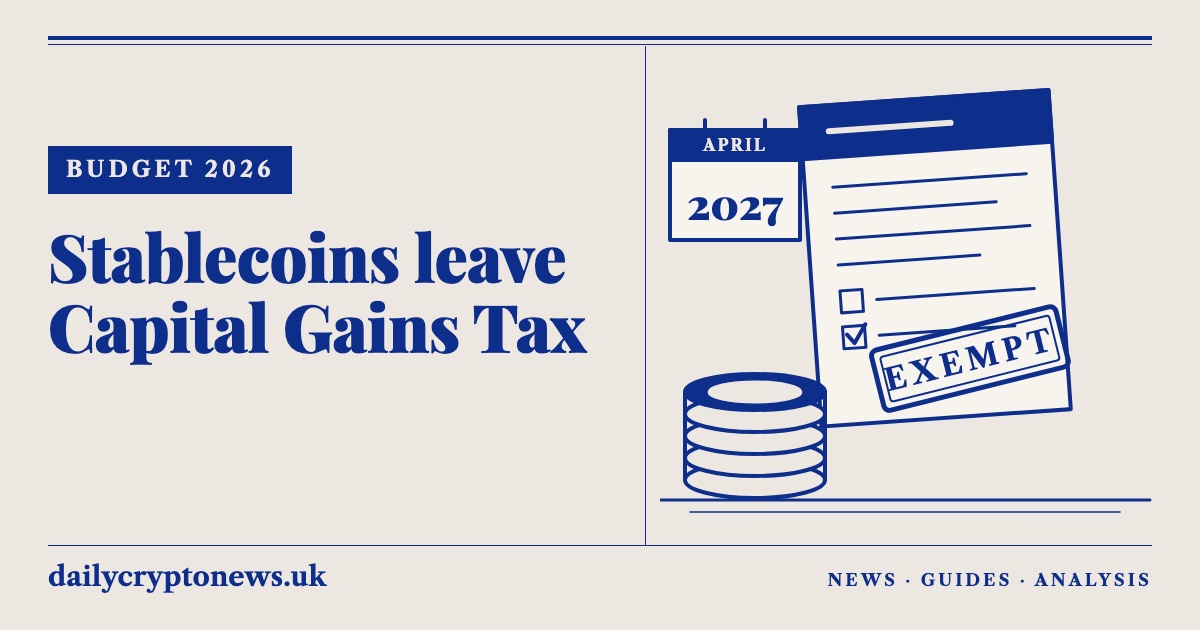
From 6 April 2027, gains you make when you dispose of an "eligible stablecoin" will no longer be chargeable to Capital Gains Tax. The Budget on 28 October confirmed it, along with a separate change that stops ordinary DeFi lending and liquidity pool deposits from triggering a tax bill. Neither is law yet, and neither makes swapping bitcoin into USDC tax-free.
That last point is the one people are already getting wrong online. Here's what actually changes, what doesn't, and the slightly odd one-off calculation waiting for anyone who still holds stablecoins next April.
What did the Budget announce about stablecoins?
The government will treat eligible stablecoins "more like money" for tax. For individuals and trustees, disposals become exempt from Capital Gains Tax from 6 April 2027, and interest-like returns from lending them are taxed as savings income. Companies move to the loan relationship rules from 1 April 2027.
This wasn't a Budget-day surprise. HMRC ran a call for evidence from 26 March to 7 May 2026, then published draft legislation and a summary of responses on 13 July. The Budget confirmed the plan and updated the policy paper. HMRC reckons around 1.2 million people in the UK use stablecoins, and it expects the cost to the Treasury to be negligible in every year it has forecast.
There's a stated reason behind it, too. The policy paper says stablecoins are designed as a means of payment rather than an investment, and that the tax rules should reflect that to support their use for payments in the UK. Paying for a coffee with USDC and having to work out a capital gain on 3.60 tokens is, after all, a bit absurd.
Until Parliament passes the bill, though, this is a confirmed plan rather than law. The details could still shift.
Which stablecoins will count as "eligible"?
Broadly, a token qualifies if it's reasonable to assume enough currency or other assets are held to keep its value stable against sterling or another currency, and it's designed for payments or settlement. It also has to be widely available, with enough trading to form an active market. HMRC hasn't published a list of qualifying coins.
The draft wording in new section 269A of the Taxation of Chargeable Gains Act matters here, so it's worth reading closely. A few things stand out:
- It isn't limited to sterling. The test says "sterling or another currency", so dollar and euro stablecoins aren't excluded just because of the currency they track.
- Backing is part of the test. A token has to have a "sufficient amount" of currency or other assets held behind it. Our reading is that purely algorithmic coins with no real reserve would struggle to qualify.
- Its own tokens don't count as backing. The draft excludes cryptoassets of the same type from the reserve.
- The FCA isn't mentioned. Nothing in the draft ties tax status to FCA authorisation, so the tax test and the UK's separate stablecoin regulation are two different questions.
So do USDC and USDT qualify? On the wording, the two biggest dollar coins look like the obvious fit, being widely traded, reserve-backed and used for settlement. But that's our reading. HMRC hasn't named any tokens, and "reasonable to assume" leaves room for argument over smaller or newer coins, and over yield-bearing products that are sold as stablecoins but behave more like funds. If you hold something unusual, treat its status as unknown until HMRC guidance lands. Our USDT vs USDC guide covers how the two differ on reserves.
Does swapping crypto into a stablecoin become tax-free?
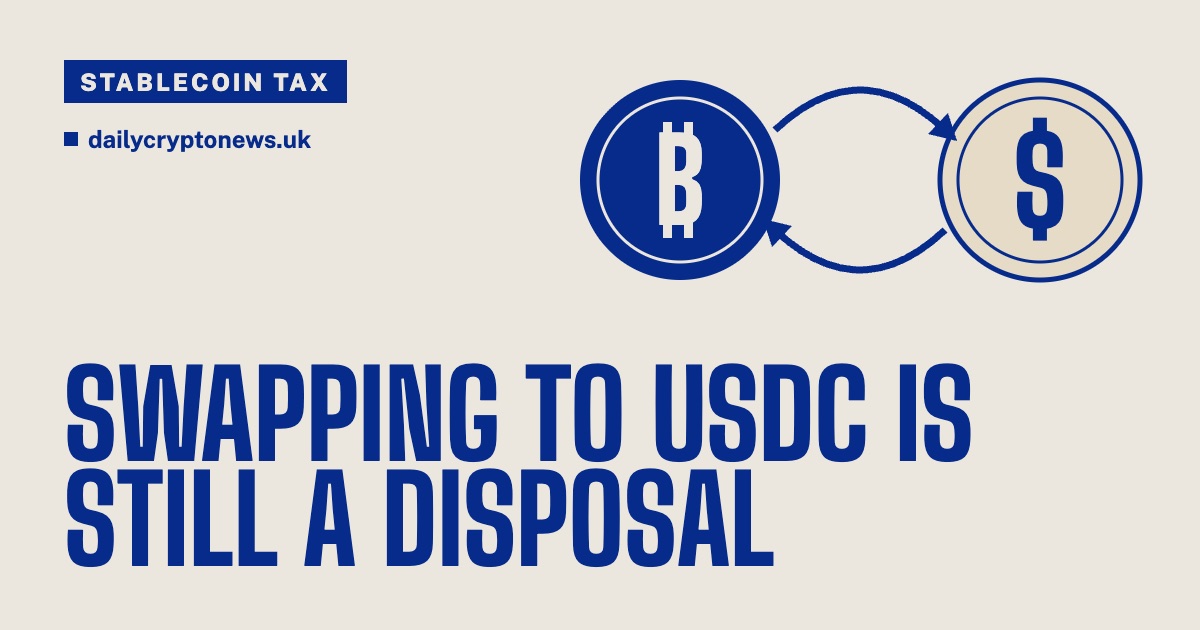
No. Swapping bitcoin, ether or any other token into a stablecoin is still a disposal of the token you give up, and HMRC still taxes any gain on it. The exemption only covers gains on the stablecoin itself, so you'd pay tax on the bitcoin leg exactly as you do today.
HMRC's manual already says that exchanging one cryptoasset for another is a disposal, and nothing in the Budget changes that. Our earlier piece on crypto-to-stablecoin swaps has worked examples. What does change is the next step: selling or spending the stablecoin.
| Transaction | Today | From 6 April 2027 (if enacted) |
|---|---|---|
| Swap BTC or ETH for USDC | Disposal of the BTC or ETH: gain taxable | Unchanged: gain on the BTC or ETH is still taxable |
| Sell an eligible stablecoin for pounds | Disposal: gain or loss in sterling | Gain not chargeable |
| Swap one eligible stablecoin for another | Disposal of the first coin | Gain not chargeable |
| Use an eligible stablecoin to buy ETH | Disposal of the stablecoin | Gain on the stablecoin not chargeable; ETH acquired at its sterling value |
| Earn interest-like returns lending stablecoins | Income or capital, depending on the terms | Taxed as savings income (interest) |
| Put tokens into a qualifying lending arrangement or liquidity pool | Can be a disposal | Generally no gain, no loss |
One thing the papers don't spell out is losses. The usual rule in section 16 of the 1992 Act is that where a gain wouldn't be chargeable, a loss on the same disposal isn't allowable either. So once the exemption starts, we'd expect losses on eligible stablecoins to stop counting too. HMRC hasn't said so directly in the documents we've read.
Why does a $1 coin create a gain in pounds at all?
Because HMRC measures everything in sterling. A dollar stablecoin holds steady against the dollar, not the pound, so when the exchange rate moves your USDC rises or falls in pounds. That's where most UK stablecoin gains and losses come from, and it's why the change matters even for people who never trade.
It also explains the one-off calculation. Under the draft, if you hold an eligible stablecoin immediately before 6 April 2027, you're treated as selling it and buying it back at market value at that moment. Any gain or loss is treated as arising on 6 April 2027, which puts it in the 2027 to 2028 tax year. The updated policy paper adds that individuals and trustees can elect to defer that transitional gain or loss until they actually dispose of the coins. The July draft didn't include that election, so the details should appear in the bill itself.
Here's how it might play out. The exchange rates are made up for illustration, and we've ignored fees and assumed the coin holds exactly $1.
| Pound strengthens | Pound weakens | |
|---|---|---|
| You bought 20,000 USDC when £1 = $1.25 | Cost: £16,000 | Cost: £16,000 |
| Rate just before 6 April 2027 | £1 = $1.35 | £1 = $1.15 |
| Market value then | £14,815 | £17,391 |
| Transitional result | Loss of about £1,185 | Gain of about £1,391 |
For most people the numbers will be small, and the annual exempt amount (£3,000 in 2026 to 2027) will often cover them. Above that, gains are taxed at 18% or 24% depending on your income. If you have a transitional loss, whether it's better to take it in 2027 or defer it is exactly the sort of question to check once the final rules and any election deadline are published.
What changes for DeFi lending and liquidity pools?
From 6 April 2027, lending tokens through a qualifying arrangement, or depositing them in a qualifying liquidity pool, will generally be treated as no gain, no loss. You'll be taxed when you make a real economic disposal, not when tokens move into a protocol. HMRC estimates this affects around 700,000 people.
This one has been a long time coming. HMRC asked for evidence in summer 2022 and consulted between 27 April and 22 June 2023. Our DeFi tax explainer covers the rules as they stand today, which can treat moving tokens into a pool as a taxable disposal even though nothing has really been sold.
Under the new policy paper:
- Lending: entering or leaving a single-cryptoasset lending arrangement, where you get back the same type of token, is no gain, no loss.
- Borrowing: borrowed tokens are treated as acquired at market value when you borrow them, and collateral you post is ignored for Capital Gains Tax.
- Liquidity pools: putting tokens into a qualifying automated market maker is no gain, no loss. If you get back a different quantity of a token than you put in, though, that difference produces a gain or a loss.
That last rule is how impermanent loss will show up in your tax records. It's a sensible design, honestly. You pay tax on what actually changed in your holdings, not on paper movements between wallets and smart contracts. The policy paper doesn't set out how the return itself is taxed, so keep treating rewards as you do now until HMRC says otherwise. Our guide to staking, lending and airdrop income has the current position.
What should UK crypto holders do before April 2027?
Mostly, keep records and don't rush. Nothing changes for disposals before 6 April 2027, so a stablecoin sale this winter is taxed under today's rules. The useful work is making sure your sterling cost for every stablecoin holding is accurate before that date, because it will set your one-off gain or loss.
A short checklist:
- Pull your history now. Download full transaction records from every exchange you've used, including closed accounts. Your gains calculation depends on pooled costs, and pools are hard to rebuild from memory.
- Separate stablecoins from everything else. Each token type has its own pool. Mixing USDC into a general "crypto" figure will make the April 2027 calculation impossible.
- Don't trade purely for the tax change. Selling bitcoin into USDC now still crystallises a gain on the bitcoin. The exemption doesn't touch that.
- Expect HMRC to see the data. UK crypto platforms have collected customer data under CARF since 1 January 2026, with first reports due by 31 May 2027. More in our CARF explainer.
- Watch for the bill and HMRC guidance, particularly on which coins qualify and how the deferral election works.
Our take is that this is a good change that's been overdue for years. Taxing the currency wobble on a payment token was always a strange outcome, and the DeFi fix ends some genuinely unfair dry tax charges. The weak spot is the "reasonable to assume" eligibility test. Until HMRC gives examples, holders of anything less mainstream than USDC or USDT are left guessing.
Frequently asked questions
Are stablecoins exempt from Capital Gains Tax in the UK? Not yet. The government has confirmed that, from 6 April 2027, gains on disposals of eligible stablecoins by individuals and trustees won't be chargeable gains. Until then, selling, swapping or spending a stablecoin is a normal disposal, and you work out any gain or loss in pounds.
Will USDC and USDT be eligible stablecoins? HMRC hasn't named any coins. The draft test covers reserve-backed tokens that track sterling or another currency, are designed for payments and are widely traded. USDC and USDT look like the obvious fit on that wording, but that's our reading, not HMRC confirmation.
Is swapping bitcoin for a stablecoin tax-free from April 2027? No. You're still disposing of the bitcoin, so any gain on it is taxable at 18% or 24% above your annual exempt amount. Only the gain on the stablecoin itself, when you later sell or spend it, falls outside Capital Gains Tax.
What happens to stablecoins I already hold on 6 April 2027? Under the draft, you're treated as selling and immediately buying them back at market value just before 6 April 2027, with any gain or loss arising on that date. The updated policy paper says individuals can elect to defer that gain or loss until they actually dispose of the coins.
Is interest on stablecoins taxed differently from 2027? Yes. Interest-like returns from lending eligible stablecoins will be taxed as interest under the savings income rules. Today, HMRC's treatment of returns from crypto lending depends on the arrangement, and can be income or capital.
The practical next step
Before next April, get a clean sterling cost figure for every stablecoin you hold and file it with your records, then check the details again when the bill is published. If you'd like the full picture of how crypto gains are worked out now, start with our UK crypto Capital Gains Tax guide. This is general information, not tax or financial advice. The rules described here are proposals until Parliament passes them, and crypto is high risk: you could lose everything you put in.
Sources
- HMRC policy paper: Taxation of stablecoins (updated 28 October 2026)
- HMRC: Tax treatment of stablecoins, draft legislation (accessible version)
- HMRC: Taxation of stablecoins, call for evidence outcome
- HMRC policy paper: Tax treatment of cryptoasset loans and liquidity pools (updated 28 October 2026)
- GOV.UK: Budget 2026 tax-related documents
- Stephenson Harwood: The Autumn Budget 2026, key changes affecting individuals and trusts (30 October 2026)
- Skadden: 'And now, exhale', UK Autumn Budget 2026
- legislation.gov.uk: Taxation of Chargeable Gains Act 1992, section 16 (losses)
- HMRC Cryptoassets Manual CRYPTO22100: what is a disposal
- GOV.UK: Capital Gains Tax rates
- GOV.UK: Capital Gains Tax allowances
Sam Whitfield
Sam Whitfield is the pen name of the editor of Daily Crypto News UK, who writes and reviews every article on the site.