What Happens When an Exchange Delists a Token You Hold? A UK Guide (2026)
When an exchange delists a token, trading stops first and withdrawals close later. Here's the timeline, how to withdraw to a wallet, the tax on forced conversions and your complaint options.
By Sam Whitfield, Editor · Published · 6 min read
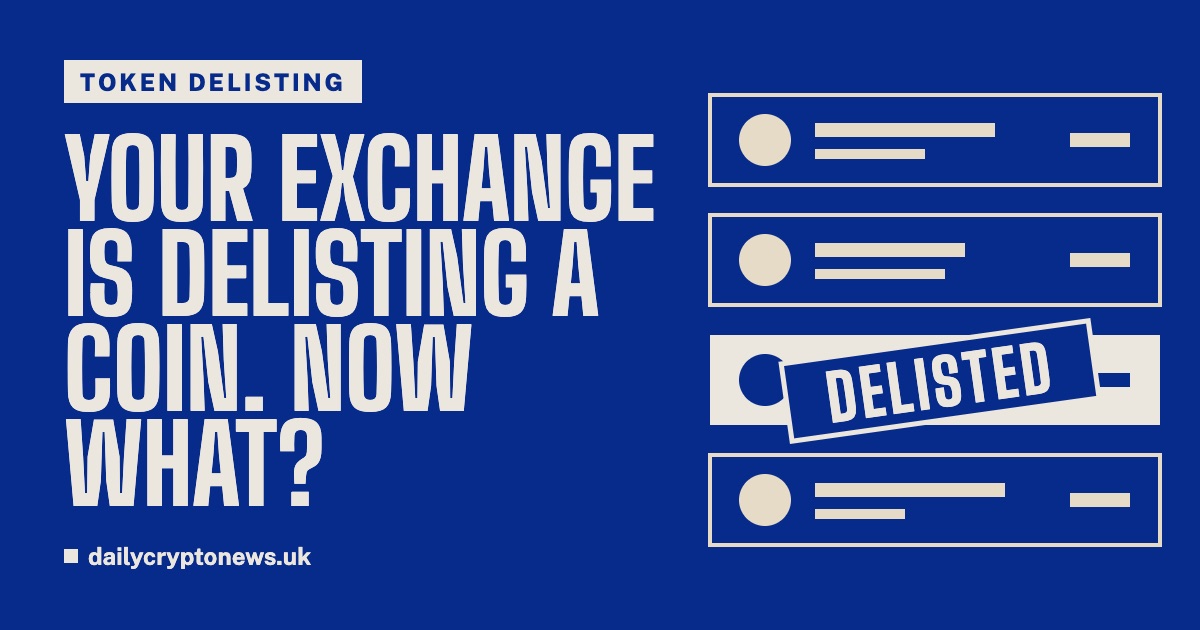
When an exchange delists a token, it stops trading that token on a set date, then stops accepting deposits, and finally closes withdrawals weeks or months later. Your tokens don't vanish. You can usually sell before trading ends or withdraw them to your own wallet before the withdrawal deadline. Miss both, and you're relying on whatever the exchange chooses to do with leftovers.
It's a live question this week. On 14 October 2026 Binance announced it would delist Epic Chain (EPIC) and QuickSwap (QUICK), and Crypto Briefing reports both tokens had sat under its Monitoring Tag for months. Crypto.news, citing CoinGecko, reported QUICK down about 20% and EPIC about 11% over the 24 hours around the news. Here's what a delisting means for a UK holder.
What happens to my tokens when an exchange delists them?
Nothing happens to the tokens themselves; they still exist on their blockchain. What changes is what the exchange will do with them. Trading pairs are removed, then deposits stop being credited, then withdrawals close. Until the last deadline, you can still move tokens out to a wallet you control.
Delisting is a decision by one company about one platform. The token may still trade elsewhere, often on decentralised exchanges, though usually with thinner liquidity and wider spreads after a big venue drops it. Prices tend to fall on the announcement, as the EPIC and QUICK moves show, because a large pool of buyers disappears.
Binance cites its periodic reviews when it delists. Factors it says it weighs include liquidity, trading volume, development activity, security and the project team's commitment. It didn't give a specific reason for EPIC and QUICK.
How long do I have before a delisting takes effect?
Usually a couple of weeks before trading stops and a couple of months before withdrawals close, but it varies by exchange. Read the announcement itself and note every date. Features like margin, futures, earn products and convert tools are often switched off first, sometimes within a day of the notice.
Here's how Binance's 14 October announcement for EPIC and QUICK lays out, based on CryptoTicker's summary of the notice (times are UTC):
| Date (2026) | What stops |
|---|---|
| 15 October | Buy and Sell route removed; margin borrowing suspended |
| 20 October | Futures positions closed; margin, loans and Binance Pay removed |
| 21 October | Simple Earn positions unwound to Spot |
| 28 October, 03:00 | Spot trading ends; open orders cancelled |
| 29 October, 03:00 | Deposits no longer credited |
| 28 December, 03:00 | Withdrawals end |
| From 29 December | Binance may convert leftovers to a stablecoin, not guaranteed |
That's roughly two weeks to sell on the platform and about ten weeks to withdraw. Other exchanges run tighter or looser schedules, so don't assume these dates apply elsewhere.

Should I sell, withdraw to a wallet, or wait?
That's your call, and it depends on whether you still want to hold the token. Selling before trading ends gets you out at whatever price is available. Withdrawing to your own wallet keeps the tokens. Waiting past the withdrawal deadline is the riskiest choice, because conversion afterwards is at the exchange's discretion.
If you withdraw, check the network first. Many tokens exist on more than one blockchain, and sending on the wrong network is a common way to lose them. Make sure your wallet supports the exact token contract, send a small test amount, then the rest. Leave enough for the withdrawal fee. Our guides to sending and receiving crypto and self-custody cover the basics.
A word of caution, and it's my view rather than a rule: delistings attract scammers. Expect fake support accounts offering to rescue your stranded tokens or migrate them for a fee. Exchanges announce real deadlines on their own announcements pages, so check there, never through a link in a DM.
Is a forced conversion taxable?
Yes. If the exchange converts your delisted tokens into a stablecoin, HMRC treats it as a disposal, the same as if you'd swapped them yourself. You work out a gain or loss in pounds, using the sterling value of the stablecoin received against your pooled cost. Selling before the deadline is a disposal too.
Most people holding a token through a delisting will be sitting on a loss, which can be useful. A realised loss can be set against other gains in the same tax year, or carried forward if you report it to HMRC. Here's an example. You bought 10,000 tokens for £2,000. After the price slide, the exchange converts them into stablecoins worth £600. That's a £1,400 allowable loss you should report.
Withdrawing to your own wallet isn't a disposal, because you still own the tokens. If they later become practically worthless, HMRC's negligible value rules at CRYPTO22500 let you claim as though you'd sold and reacquired them, crystallising the loss. The claim has to cover your whole pool of that token. Our guide to crypto tax losses covers how to claim. This isn't tax advice.
Can I complain if an exchange delists a token I hold?
You can complain to the exchange, but your options beyond that are limited. Delisting decisions are normally allowed under the platform's terms. UK crypto firms are currently registered with the FCA only for anti-money-laundering purposes, and many overseas exchanges aren't registered at all. Neither generally gives you access to the Financial Ombudsman for the crypto itself.
That changes in part when the FCA's new crypto regime starts on 25 October 2027. The FCA's consultation proposed that complaints about authorised crypto firms with a UK establishment should go to the Ombudsman, but it flagged no Ombudsman access for customers of overseas firms without one. The FCA published its final crypto rules on 30 June 2026, so check those for the settled position. In practice, if you use an offshore exchange, expect to rely on its own complaints process and terms, and keep screenshots of announcements and balances. Our explainer on crypto and the Financial Ombudsman goes into the detail.
Frequently asked questions
Do I lose my crypto if it's delisted? No. The tokens still exist on their blockchain. You can usually sell before trading ends or withdraw them to your own wallet before the withdrawal deadline. The risk comes if you miss every deadline and the exchange chooses not to convert leftover balances.
How long do I have to withdraw a delisted token? It depends on the exchange. In Binance's EPIC and QUICK delisting, spot trading ends on 28 October 2026 and withdrawals close on 28 December 2026, about ten weeks after the announcement. Always check the exchange's own announcement for exact dates.
Is it taxable if the exchange converts my delisted tokens? Yes. A conversion into a stablecoin or another token is a disposal for Capital Gains Tax. You calculate the gain or loss in pounds at the time. Many delisted tokens are held at a loss, which you can report and set against other gains.
Can I go to the Financial Ombudsman about a delisting? Usually not at the moment, because most crypto exchanges aren't yet authorised for crypto activities. Under the FCA regime starting 25 October 2027, complaints about authorised firms with a UK establishment are expected to go to the Ombudsman, but customers of overseas firms may still lack access.
Where can I still trade a token after it's delisted? Possibly on other centralised exchanges or decentralised exchanges, if it's listed there, though liquidity is often much thinner after a large exchange drops a token. Check the contract address carefully to avoid fake versions.
If you hold a token being delisted
Write down every date in the announcement, decide whether you want to keep the token, and act well before the withdrawal deadline. Test small transfers first, ignore anyone offering to help by DM, and record any sale or conversion for HMRC. If your exchange itself is the worry, our guide to what happens if a crypto exchange goes bust is the next read.
Sources
- CryptoTicker: Binance delisting EPIC and QUICK, deadlines explained
- Crypto Briefing: Binance will delist EPIC and QUICK on 28 October 2026
- Crypto.news: Binance delisting sends QUICK down 20% and EPIC 11%
- HMRC Cryptoassets Manual CRYPTO22100: what is a disposal
- HMRC Cryptoassets Manual CRYPTO22500: negligible value claims
- FCA: CP25/25 Application of FCA Handbook for regulated cryptoasset activities
Sam Whitfield
Sam Whitfield is the pen name of the editor of Daily Crypto News UK, who writes and reviews every article on the site.