FCA Wants Extra Checks on Personal Crypto Wallets: What Changes for You?
The FCA's new draft guidance lists enhanced due diligence on transfers to and from personal crypto wallets as good practice. It isn't a new rule or a ban on self-custody, but it may mean more questions when you withdraw. Here's what the consultation says and how to keep your transfers moving.
By Sam Whitfield, Editor · Published · 7 min read
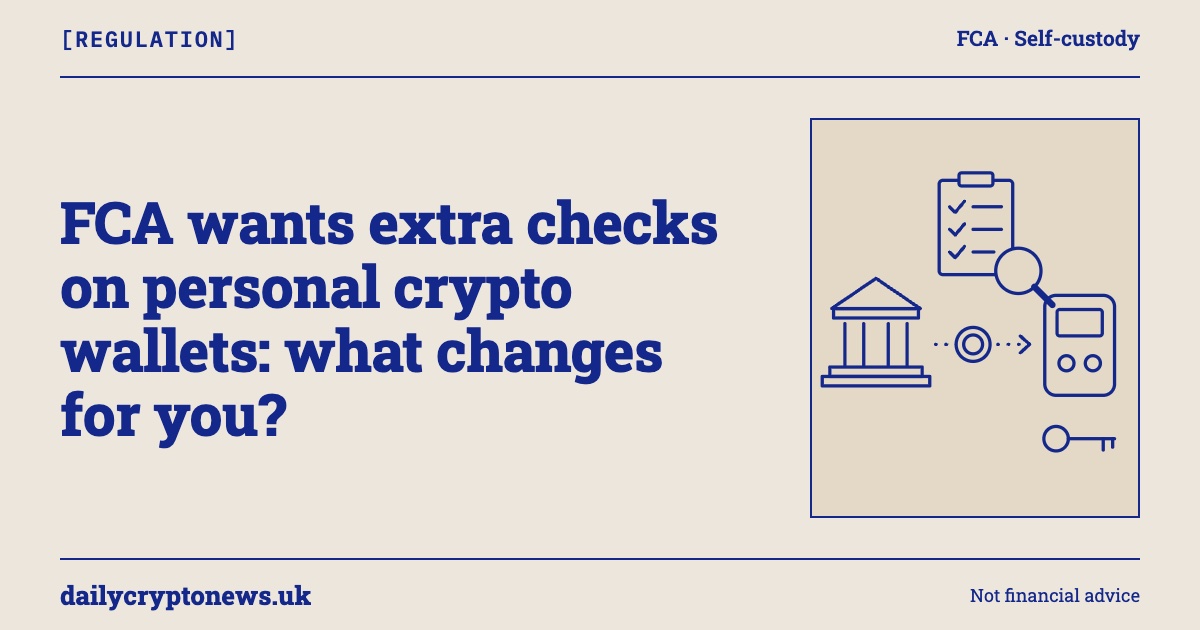
No, the FCA isn't banning personal crypto wallets, and nothing changes overnight. On 23 October 2026 it published draft updates to its Financial Crime Guide (consultation CP26/38) that list enhanced due diligence on transactions involving "unhosted" wallets as an example of good practice for crypto firms. The guide sets no new rules. In practice, though, it may mean more questions when you move coins between an exchange and your own wallet.
The consultation runs until 24 December 2026. Here's what it actually says, what it doesn't, and what you can do now so your withdrawals don't get stuck.
What has the FCA actually proposed?
The FCA wants to update its Financial Crime Guide, the handbook of examples it gives firms about anti-money laundering controls. For crypto, the draft adds examples of good and poor practice on when to apply enhanced due diligence, how to use blockchain analytics, and how to handle the Travel Rule. Personal wallets appear in two of those good-practice examples.
The wording matters, so here it is in plain terms. In the draft section on higher-risk situations, the FCA says a firm should consider when crypto customers or transactions present a higher money laundering risk, and apply enhanced checks "as appropriate", including where transactions are funded by unhosted wallets or involve mixers, tumblers or privacy coins. A second example simply says a firm applies enhanced due diligence for transactions involving unhosted wallets.
Other crypto examples in the draft include:
- Good practice: using blockchain analytics in source-of-funds checks, and to flag links to privacy layers, tumblers or mixers.
- Good practice: screening wallet addresses against the UK Sanctions List on an ongoing basis, not just at sign-up.
- Poor practice: a rigid rule on how many "hops" back a firm traces a transaction, with no allowance for risk.
- Poor practice: relying on a third-party risk score the firm can't explain or evidence.
The reason given is the 2025 National Risk Assessment, which the FCA says ranked the money laundering risk for cryptoassets as "high". The FCA is also preparing firms for the new authorisation regime that starts on 25 October 2027 (we covered how the FCA's crypto authorisation gateway works).
Is this a new law or a ban on self-custody?
Neither. The FCA states plainly that the Financial Crime Guide "does not contain rules" and doesn't impose new requirements. It's guidance firms are expected to read and weigh against their own judgement. Holding crypto in your own wallet stays legal in the UK, and nothing in CP26/38 restricts it.
That said, I wouldn't shrug it off. Guidance shapes behaviour. Compliance teams at UK exchanges read examples of "good practice" as what a supervisor will look for, and the cautious response is usually to ask customers more questions. So the real-world effect is likely to be friction, not prohibition.
There's a nuance worth holding onto here. The FCA's examples are risk-based: "as appropriate", "may present a higher risk". It also lists a rigid, one-size-fits-all tracing rule as poor practice. Read fairly, the draft doesn't tell firms to treat every withdrawal to a hardware wallet as suspicious. Whether every firm reads it that fairly is another matter.
What do UK exchanges already ask about personal wallets?
Quite a lot, already. Since 1 September 2023 the UK's crypto Travel Rule has applied, and regulation 64G of the Money Laundering Regulations covers transfers to and from unhosted wallets. It lets a firm ask its customer for information about the transfer, and requires the firm to weigh the risk when deciding whether to ask.
The detail of regulation 64G, as it stands on legislation.gov.uk:
| What the law says | What it means for you |
|---|---|
| A firm may request information from its customer on an unhosted wallet transfer | You may be asked who owns the wallet, or what the transfer is for |
| For incoming transfers of £800 or more (with linked transfers added together), it may ask for details of the sender | Deposits from a wallet could prompt questions about where the coins came from |
| The firm must weigh the purpose, value, frequency and the length of your relationship | A long-standing customer moving modest sums to their own wallet should, in theory, see fewer checks |
| If you don't provide requested information on an incoming transfer, the firm must not release the crypto to you | Unanswered questions can freeze a deposit |
The £800 figure was set by an amendment that took effect on 30 June 2026. More on the wider Travel Rule in our Travel Rule explainer.
So CP26/38 doesn't invent wallet checks. It nudges firms to treat them as part of enhanced due diligence when the risk calls for it, and to back them up with blockchain analytics.
How could this affect your withdrawals and deposits?
Expect more prompts, not blocks, for ordinary transfers. The most likely changes are extra questions when you add a new withdrawal address, requests to confirm the wallet is yours, source-of-funds questions on larger deposits, and occasional delays while a firm reviews a transfer its analytics have flagged.
Some exchanges already ask customers to prove they control a personal wallet, for example by signing a message with it or sending a small test amount first. If you've never done that, it's simple enough, and it beats a withdrawal sitting in review over a weekend, which, for some reason, is always when these things happen.
What raises the odds of a closer look, going by the FCA's own examples:
- Coins that have passed through a mixer or tumbler.
- Privacy coins.
- Large or unusual transfers that don't fit your normal pattern.
- Wallets linked by analytics to scams, darknet markets or sanctioned addresses, even if you didn't know it.
That last one is the frustrating bit. If you bought crypto peer to peer, or received it from someone else, it may carry history you can't see. It's one reason we suggest buying through FCA-registered firms and keeping records, as in our guide to proving source of funds for crypto.
What can you do now to avoid problems?
Keep your own paperwork tidy and be ready to show the wallet is yours. Most delays come from a firm asking a question and not getting a clear answer quickly. If you can explain a transfer in a sentence and back it with a record, you're in a good position.
A short checklist:
- Reuse a small number of personal addresses and label them in your exchange account, rather than a fresh address every time.
- Do a small test transfer first when you add a new wallet. It costs a fee but limits the damage from a typo.
- Know how to sign a message with your wallet software, in case you're asked to prove control.
- Keep records: purchase confirmations, exchange statements and transaction IDs. You need these for HMRC anyway (see our capital gains tax guide).
- Answer questions honestly and promptly. "It's my hardware wallet, I'm moving my holdings into self-custody" is a normal answer.
- Avoid mixers and privacy tools on coins you'll later send to a UK exchange. Whatever your reasons, they're the clearest trigger for enhanced checks.
If you're weighing up self-custody in the first place, our bitcoin self-custody guide and cold wallet vs hot wallet comparison cover the trade-offs. Nothing here changes the basic case for or against it.
Can you respond to the FCA consultation?
Yes. CP26/38 is open to anyone, not just firms, and closes on 24 December 2026. The FCA takes responses through its online form or by email to cp26-38@fca.org.uk. Responses may be published, so read the FCA's note on confidentiality first and say whether you're happy for your name to appear.
Final wording will come in a later policy statement. If you care about proportionate treatment of self-custody, the useful thing to say is specific: how checks affect you, which ones are reasonable, and where blanket rules would bite. Running commentary on X won't reach the people drafting the guide. A two-paragraph email will.
Frequently asked questions
What is an unhosted wallet? It's a crypto wallet where you hold the private keys yourself, rather than a firm holding them for you. Hardware wallets, and software wallets like mobile or browser apps where you control the seed phrase, are unhosted. An exchange account is a hosted, or custodial, wallet.
Is the FCA banning self-custody crypto wallets? No. CP26/38 proposes updates to the FCA's Financial Crime Guide, which the FCA says contains no rules and imposes no new requirements. It lists enhanced due diligence on unhosted wallet transactions as good practice for firms. Holding crypto in your own wallet remains legal in the UK.
When does the FCA's unhosted wallet guidance take effect? It's a draft. The consultation opened on 23 October 2026 and closes on 24 December 2026, and the FCA will publish final text in a later policy statement. Separately, the new FCA authorisation regime for crypto firms starts on 25 October 2027.
Why is my exchange asking about my personal wallet? UK crypto firms must follow anti-money laundering rules, including the Travel Rule. Regulation 64G of the Money Laundering Regulations lets them request information on transfers to or from unhosted wallets, weighing the risk, and for incoming transfers of £800 or more they may ask about the sender.
Will I have to prove I own my wallet? Possibly. Some UK exchanges already ask customers to confirm control of a personal wallet, for example by signing a message or sending a small test amount. CP26/38 doesn't set a specific method, so what you're asked depends on your exchange's own risk-based controls.
The practical next step
If you move crypto between a UK exchange and your own wallet, spend ten minutes this week labelling your withdrawal addresses, checking you can sign a message from your wallet, and saving your transaction records somewhere safe. That covers almost everything the new guidance is likely to make firms ask. This is general information, not legal or financial advice. If you're unsure about a specific transfer, ask your exchange or a regulated adviser.
Sources
- FCA: CP26/38 Financial Crime Guide updates (23 Oct 2026)
- FCA: Consultation Paper CP26/38 (PDF)
- legislation.gov.uk: Money Laundering Regulations 2017, regulation 64G (unhosted wallet transfers)
- FCA: FCA sets out expectations for UK cryptoasset businesses complying with the Travel Rule
- CryptoSlate: FCA proposes personal-wallet checks in nonbinding crypto guidance (26 Oct 2026)
Sam Whitfield
Sam Whitfield is the pen name of the editor of Daily Crypto News UK, who writes and reviews every article on the site.