Crypto-Backed Loans in the UK: Can You Borrow Against Your Bitcoin, and What Does HMRC Say?
Yes, UK holders can borrow against bitcoin and ether, and Coinbase brought USDC loans to the UK in April 2026. But posting collateral can itself be a taxable disposal today, liquidation can sell your coins at the worst moment, and the FCA's retail protections don't start until October 2027.
By Sam Whitfield, Editor · Published · 10 min read
Yes, you can borrow against your crypto in the UK. Platforms will lend you a stablecoin such as USDC if you lock up bitcoin or ether as collateral, and Coinbase brought exactly that product to UK users in April 2026. The catch is in three places: the tax on posting collateral, the risk of liquidation, and the fact that the FCA's retail protections for these loans don't apply until 25 October 2027.
The pitch is always the same. Keep your bitcoin, get spending money, and don't trigger Capital Gains Tax by selling. Some of that holds up. Some of it doesn't, and the part that doesn't can cost you real money.
How does a crypto-backed loan work?
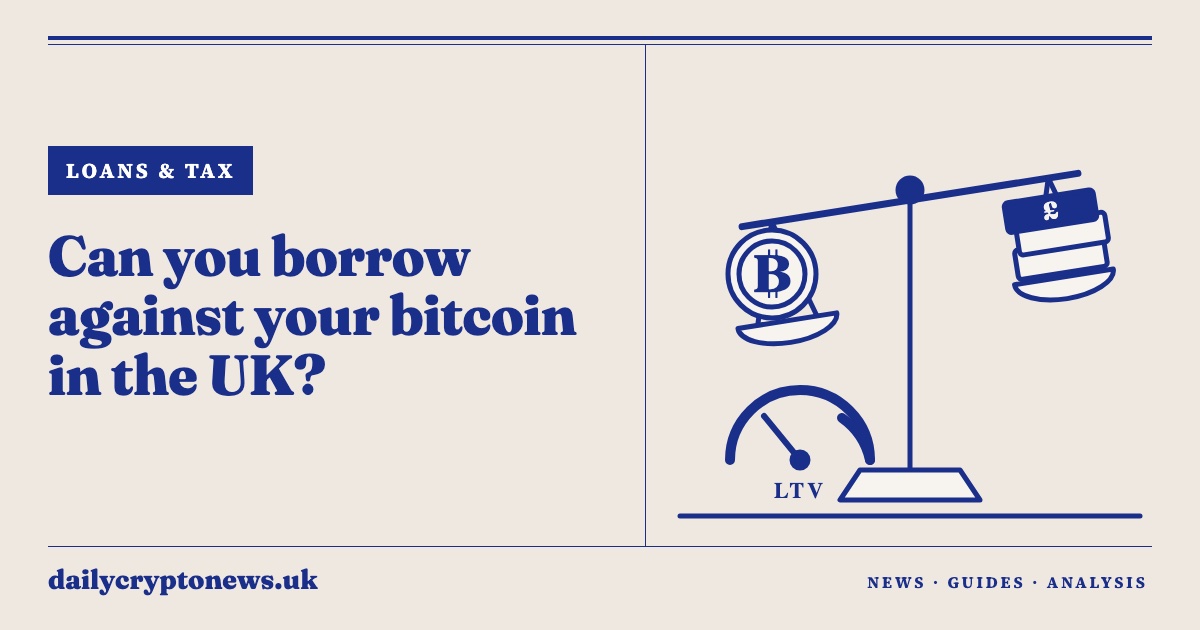
You deposit crypto as collateral, and the platform lends you something else, usually a dollar stablecoin, worth a fraction of that collateral. The fraction is the loan-to-value ratio, or LTV. You pay interest, and if your collateral's price falls far enough that the LTV crosses the platform's liquidation threshold, your collateral is sold to repay the loan.
Here's the shape of the one product most UK readers will have seen advertised. Coinbase launched crypto-backed USDC loans in the UK on 20 April 2026, according to The Block and Cointelegraph. The details reported at launch:
- Collateral: bitcoin, ether and cbETH (Coinbase's wrapped staked ether).
- What you borrow: USDC, up to $5 million on bitcoin-backed loans.
- How it runs: through Morpho, a lending protocol on the Base network. Rates are variable and recalculated as each block is produced, so they can move every few seconds.
- Repayment: no fixed schedule. You can repay whenever you like, and you get liquidation alerts by email and text.
Notice what you actually receive: USDC, not pounds. If you want sterling, you then sell the USDC, which is a separate transaction with its own spread or fee. And note that this runs on a DeFi protocol, not on a bank's balance sheet. That matters later for both tax and regulation.
When does a crypto loan get liquidated?
When your loan grows too large relative to your collateral. Each platform sets a liquidation threshold, an LTV at which it sells some or all of your collateral to clear the debt, often with a penalty on top. A sharp price fall is the usual trigger, but interest added to the loan pushes the LTV up too.
The maths is simple enough to do on the back of an envelope. Your liquidation point is the loan divided by the threshold. Here's a worked example with round numbers. The 85% threshold is illustrative only; use the figure your own platform shows you.
| Your position | Borrow 30% (LTV 30%) | Borrow 50% (LTV 50%) |
|---|---|---|
| Bitcoin collateral, today's value | £40,000 | £40,000 |
| Loan | £12,000 | £20,000 |
| Collateral value at which an 85% threshold is hit | £14,118 | £23,529 |
| Price fall that triggers liquidation | about 65% | about 41% |
A 41% fall sounds like a lot. Bitcoin has done it before, more than once, and it doesn't always take months. Borrowing half your coin's value means a bad few weeks could sell your bitcoin near the bottom, which is the exact outcome you took the loan to avoid. If you want to see how fast forced selling cascades, our explainer on crypto liquidations walks through a recent example.
My view, for what it's worth: if you can't stomach a 30% LTV, the loan is probably too big for your situation. Lower is calmer.
Is posting crypto as collateral a taxable disposal in the UK?
It can be, today. HMRC's manual says it depends on the platform's terms. If the platform can "deal as it wishes" with your collateral, that strongly suggests it has acquired beneficial ownership, so you've disposed of your tokens for Capital Gains Tax. If it's specifically restricted from dealing with them, you've probably kept ownership and there's no disposal.
HMRC's manual is written for DeFi lending platforms, but the same beneficial-ownership question is the natural starting point for any platform holding your collateral.
That's the bit most "borrow, don't sell" adverts skip. If your bitcoin has risen a long way since you bought it, and the platform's terms let it use your collateral freely, depositing it could trigger the very tax bill you were trying to defer. Gains above the £3,000 annual exempt amount are taxed at 18% or 24% depending on your income, as GOV.UK sets out.
The rest of HMRC's current guidance, from CRYPTO61630 and CRYPTO61640:
- Borrowing tokens is an acquisition. HMRC says "where a person borrows tokens, they are making an acquisition". The USDC you receive has a cost for your records.
- Liquidation is a disposal if you kept ownership. Where you didn't dispose of the collateral at the start, the platform is treated as your nominee, so tokens it sells to settle the loan are treated as disposed of by you at their sterling market value.
- Liquidation penalties aren't deductible. HMRC says the market value of tokens taken as a liquidation penalty is not an allowable deduction.
- Interest isn't an allowable cost for gains. Section 38(3) of the Taxation of Chargeable Gains Act 1992 says "no payment of interest shall be allowable", with a narrow exception for companies.
So you need to read the platform's terms on what it can do with your collateral before you deposit, not after. And keep a record of every movement, because you may need to prove which side of HMRC's line you were on.
What changes for crypto loan tax in April 2027?
A lot, if the legislation passes as planned. HMRC's policy paper, updated on 28 October 2026, says that from 6 April 2027 collateral provided under a cryptoasset borrowing arrangement will be "disregarded" for Capital Gains Tax. Borrowed tokens are treated as acquired at market value, and repaying with the same type of token is a disposal at that same value.
In plain English: posting collateral stops being a disposal question, and borrowing and repaying the same token roughly washes out. That's a sensible fix. The current beneficial-ownership test means two people doing the same thing on two platforms can get opposite tax results, which isn't fair to anyone.
A few cautions, though:
- It isn't law yet. Until it is, and until 6 April 2027 arrives, today's rules apply.
- The paper doesn't cover liquidation. It says nothing specific about what happens when collateral is sold to repay you. Assume a sale is still a sale.
- It's about borrowing cryptoassets. The paper's borrowing rules talk about cryptoassets. It doesn't address borrowing pounds against crypto.
The same Budget also moves eligible stablecoins out of Capital Gains Tax from April 2027, which matters if you borrow USDC. We cover both changes in our Budget 2026 stablecoin explainer.
What will the FCA's new rules mean for crypto borrowers?
Real protections, but not until 25 October 2027. The FCA's final rules in PS26/11, published in June 2026, require firms lending crypto to retail clients to over-collateralise loans, model them so a margin call or liquidation isn't expected in the first six months, and give negative balance protection so you can't lose more than the collateral you set aside.
That last one is worth reading twice. It means a firm can't come after the rest of your account if your collateral doesn't cover the debt. The full list, from chapter 6 of PS26/11:
| FCA rule for retail cryptoasset borrowing | What it means for you |
|---|---|
| Appropriateness test | The firm must check your knowledge and experience before lending to you |
| Express prior consent | You agree to the key terms each time a lending or borrowing service is provided |
| Mandatory over-collateralisation | Your collateral must be worth more than what you borrow |
| Six-month modelling | Loan limits set so a margin call or liquidation isn't expected in the first 6 months |
| Top-ups capped at 50% | The firm can add collateral for you, with your consent, up to 50% of your original collateral's value. You can add more yourself |
| Negative balance protection | You can't lose more than the collateral you dedicated to the loan |
| Collateral held on trust | The firm can't take ownership of your collateral, except to clear your debt |
| No proprietary tokens | Firms can't use their own tokens in retail lending and borrowing |
The FCA also says plainly that it intends to limit margin trading and leveraged services for retail clients, because it thinks they're "unsuitable for most retail clients".
Two gaps to keep in mind. First, these rules are about borrowing cryptoassets, so a stablecoin loan fits, but the FCA's definitions don't describe loans of pounds. Second, for products that route through a DeFi protocol, the FCA says its rules apply where there's "an identifiable controlling entity", with more guidance to come. How that lands for a product like Morpho-based loans isn't settled yet. Until October 2027, you're relying on each platform's own terms. The FCA's InvestSmart guidance is blunt that it's "highly unlikely you will be covered by the Financial Services Compensation Scheme" for crypto. Our summary of the FCA's 2026 crypto policy statements covers the wider regime.
Should you borrow against your crypto?
Only if you'd be fine seeing the collateral sold. A crypto-backed loan can make sense for a short, known need where you'd otherwise sell coins you want to keep, at a low LTV, on terms you've read. It makes much less sense for long-term spending, for buying more crypto, or for anything you can't repay quickly if prices fall.
Before you sign up, run through this:
- Read the collateral clause. Can the platform lend out, stake or otherwise use your coins? If yes, posting them may be a disposal under current HMRC guidance.
- Find the liquidation threshold and penalty. Work out your liquidation price with the formula above, and write it down.
- Pick a low LTV. Leave room for a 50% fall plus a few months of interest.
- Price the whole round trip. Interest, the cost of selling USDC for pounds, and the cost of buying USDC back to repay.
- Check the firm. Use the FCA register, not a link from an advert.
Small aside: borrowing to buy more crypto is the riskiest version of all this, because both sides of the trade fall at once. It's the same worry that led Barclaycard, HSBC and NatWest to block crypto on credit cards, as our guide to buying crypto with a credit card explains.
Frequently asked questions
Can you get a loan against bitcoin in the UK? Yes. Platforms lend stablecoins such as USDC against bitcoin or ether held as collateral. Coinbase launched crypto-backed USDC loans for UK users on 20 April 2026, running through the Morpho protocol on Base. Check the platform's liquidation threshold, rates and collateral terms before borrowing.
Do I pay tax when I take out a crypto-backed loan? Possibly. HMRC's current guidance says posting collateral is a disposal if the platform gains beneficial ownership, for example if it can deal freely with your tokens. If it's restricted from using them, there's usually no disposal. From 6 April 2027, collateral under qualifying borrowing arrangements is set to be disregarded.
Is a crypto loan liquidation taxable? It can be. If you kept ownership of the coins when you posted them and your collateral is sold to repay the loan, HMRC treats that sale as your disposal at sterling market value. If posting them was already a disposal, the liquidation itself has no further gains consequences. Any liquidation penalty can't be deducted, and loan interest isn't an allowable cost when you work out the gain.
Are crypto-backed loans regulated by the FCA? Not fully yet. The FCA's final rules for retail cryptoasset borrowing, including over-collateralisation and negative balance protection, start on 25 October 2027. Until then, protection depends mainly on each platform's terms, and crypto generally isn't covered by the Financial Services Compensation Scheme.
What is a safe loan-to-value ratio for a crypto loan? There's no safe figure, only safer ones. At a 30% LTV with an 85% liquidation threshold, bitcoin would need to fall about 65% to trigger liquidation. At 50%, about 41% would do it. Lower LTVs give you more room before your collateral is sold.
What to do now
If you're tempted, start with the platform's terms on what it does with your collateral, because that decides your tax position today. Keep the loan small, know your liquidation price, and keep records of every deposit, top-up and repayment for your Self Assessment. If it turns out the tax works out the same as selling, our UK crypto Capital Gains Tax guide will help you compare. This is general information, not financial or tax advice, and crypto is high risk: you could lose everything you put in.
Sources
- FCA PS26/11: Crypto regime, regulated cryptoasset activities (June 2026), chapter 6 Lending and borrowing
- FCA: Cryptoasset regime policy statements (30 June 2026)
- HMRC policy paper: Tax treatment of cryptoasset loans and liquidity pools (updated 28 October 2026)
- HMRC Cryptoassets Manual CRYPTO61630: Chargeable gains, borrowing
- HMRC Cryptoassets Manual CRYPTO61640: Chargeable gains, collateral
- legislation.gov.uk: Taxation of Chargeable Gains Act 1992, section 38
- GOV.UK: Capital Gains Tax rates
- The Block: Coinbase expands USDC borrowing to UK, allowing loans against bitcoin, ether (20 April 2026)
- Cointelegraph: Coinbase expands crypto-backed USDC loans to UK users (20 April 2026)
- FCA InvestSmart: Crypto basics
Sam Whitfield
Sam Whitfield is the pen name of the editor of Daily Crypto News UK, who writes and reviews every article on the site.