Sent Crypto to the Wrong Address or Network? What UK Users Can Actually Get Back
Crypto sent to the wrong address usually can't be reversed, but some mistakes are fixable. Wrong network to your own wallet or a missing exchange memo often comes back. A stranger's address or a poisoned lookalike rarely does. Here's how to tell which one you've got and what to do first.
By Sam Whitfield, Editor · Published · 11 min read
If you've sent crypto to the wrong address, nobody can press undo. A confirmed blockchain transaction is final. But "final" isn't always "lost": if the coins landed somewhere you or an exchange controls (your own wallet on the wrong network, or an exchange deposit with a missing memo), there's a decent chance of getting them back. If they went to a stranger or a scammer, the odds drop sharply.
So the first job isn't panicking. It's working out which of those situations you're in, because the next steps are completely different.
Can you reverse a crypto transaction sent to the wrong address?
No. Once a transaction is confirmed on the blockchain, no bank, exchange or regulator can reverse it. Recovery only happens if whoever controls the receiving address sends the coins back. That might be you, an exchange's support team or, occasionally, an honest stranger. Your job is to find out who holds the keys.
This is the bit that catches people coming from banking. With a mistaken bank transfer there's a sending bank, a receiving bank and a process between them. With crypto there's just a ledger, and the ledger doesn't care that you meant to type something else.
The FCA is blunt about the wider picture. Its consumer guidance says it's "highly unlikely" you'll be covered by the Financial Services Compensation Scheme for crypto losses, and that you should be prepared to lose all your money. A mis-sent transfer is your loss unless someone at the other end helps.
That said, a surprising number of "wrong address" panics turn out to be something less final. Before you assume the worst, look the transaction up on a block explorer using its transaction ID (often called a TxID or hash). Check three things: which network it went out on, the exact receiving address, and whether it's confirmed or still pending.
How do you work out where your crypto actually went?
Paste the transaction ID into the block explorer for the network it was sent on, such as Etherscan for Ethereum. Compare the receiving address character by character with the one you meant to use. Then check whether that address belongs to you, to an exchange, or to someone you don't know.
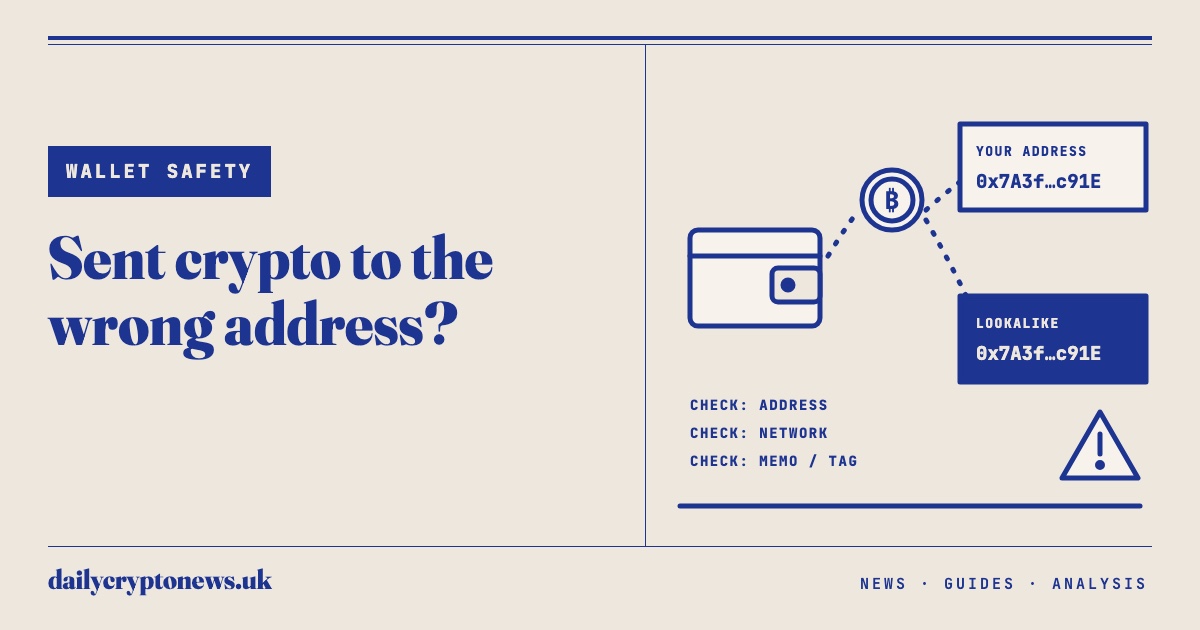
Go slowly here. Most people check the first four and last four characters and stop, which is exactly what scammers count on (more on that below).
Then sort the result into one of these buckets:
| What happened | Who controls the receiving address | Realistic chance of recovery | First move |
|---|---|---|---|
| Right address, wrong network, and it's your own self-custody wallet | You | Good | Add that network in your wallet using the same recovery phrase |
| Wrong network or unsupported token sent to an exchange deposit address | The exchange | Mixed: some recover for a fee, some can't | Contact the exchange's official support with the TxID |
| Missing memo or destination tag on an exchange deposit (XRP, XLM and similar) | The exchange | Usually good | Raise a ticket with the TxID, amount and your account details |
| Mistyped address that your wallet accepted | Probably nobody | Very low | Check it wasn't rejected or left pending first |
| Valid address belonging to someone you can't identify | A stranger | Low | Look for clues on the explorer; there's often nothing to act on |
| Lookalike address planted by a scammer (address poisoning) | The scammer | Very low | Report it, and alert any exchange the funds move to |
A quick word on typos. Most wallet software rejects a mistyped address outright, because addresses carry built-in checks. So if you think you typed it wrong, the transaction may simply have failed. Check before you grieve.
What if you sent crypto on the wrong network?
If you sent tokens on the wrong network to your own wallet, they're usually still yours. On Ethereum-style networks such as Polygon, Arbitrum and BNB Smart Chain, the same recovery phrase controls the same address, so you add the network in your wallet and the balance appears. Sending to an exchange on a network it doesn't support is harder.
The reason it works for self-custody is that these networks share Ethereum's address format. MetaMask's own documentation explains that EVM-compatible networks use the same 0x address format, so one key gives you the same address on all of them. The coins sit on a different chain, but you still hold the key that moves them. Add the network, check the balance, and you'll probably need a little of that network's gas token to move anything. (Our explainer on gas fees covers why.)
Exchanges are different. When you deposit to a Coinbase, Kraken or Binance address, the exchange holds the keys, and its systems only watch the networks it supports. Send USDT on a network the exchange doesn't credit and the tokens can sit at an address the exchange technically controls but has no process to spot.
Whether you get them back depends on the exchange. Some run paid recovery services, and some say outright that funds sent on unsupported networks are unlikely to be recoverable. Coinbase launched a self-service tool in December 2022 for unsupported ERC-20 tokens sent to Coinbase deposit addresses; at launch it charged 5% on recoveries worth over $100, plus network fees. Terms change, so check the exchange's current help pages rather than relying on old figures, ours included.
Honestly, a recovery fee is fair enough. Someone has to do manual work with keys that are normally kept well away from staff. The exchanges that shrug and say "nothing we can do" without looking are the ones worth complaining about.
What is address poisoning, and how did it get you?
Address poisoning is a scam where an attacker sends a tiny or zero-value transfer to your wallet from an address that matches the start and end of one you use. Later, you copy the "recent" address from your history and send real money to the scammer. It's common and it's cheap to run.
This is the one that stings, because you did nothing obviously careless. You copied an address from your own transaction list. The scammer simply made sure their address was sitting there, looking almost identical.
The scale is bigger than most people assume. A study by researchers at Carnegie Mellon University, measuring two years of activity on Ethereum and BNB Smart Chain, found around 270 million address poisoning attempts aimed at 17 million victims. At least 6,633 of those attempts succeeded, causing at least $83.8 million in losses. Those are on-chain measurements, so the real figure for UK users isn't known.
It's a close cousin of the dusting attack, where tiny deposits are used to track wallets. Poisoning goes a step further and relies on your copy-paste habit.
If this is what happened, recovery is unlikely. The scammer controls the key and won't return anything. Still, report it (see below), because funds that later land on a regulated exchange can sometimes be frozen. Be very wary of anyone who contacts you offering to "trace and recover" the coins for an upfront fee. That's a second scam, and we've covered how crypto recovery scams work.
Who should you contact in the UK, and in what order?
Contact whoever controls the receiving address first: your own wallet, or the exchange's official support. If you were tricked or scammed, report it to Report Fraud, which replaced Action Fraud in England, Wales and Northern Ireland in December 2025, or to Police Scotland on 101.
Here's the order that makes sense:
- Save the evidence. Screenshot the transaction on the explorer, note the TxID, the amount, the time and both addresses.
- Contact the sending platform if you sent from an exchange. It can't reverse the transfer, but it can confirm what was sent and on which network.
- Contact the receiving exchange if the coins went to an exchange address, yours or someone else's. Use the help centre you reach by typing the exchange's address into your browser, never a phone number from a search result or social media. Fake "support lines" are everywhere.
- Report scams. Report Fraud is at reportfraud.police.uk and on 0300 123 2040. If you live in Scotland, Report Fraud says to call Police Scotland on 101 instead.
- Get a reference number. Exchanges and banks often ask for one.
If you lost money to a scam, our guide to crypto scam refunds in the UK explains when a bank might share the loss, which usually depends on how the money left your bank in the first place.
Is there a legal route against a stranger who received your coins by mistake? Possibly, in theory. The Property (Digital Assets etc) Act 2025, which received Royal Assent on 2 December 2025, confirms that crypto tokens can be personal property under the law of England and Wales. But a legal claim needs a defendant, and an anonymous address isn't one. For most people, the cost of tracing someone dwarfs the amount lost. Take legal advice before spending money on it.
Can you claim a tax loss on crypto sent to the wrong address?
HMRC's manual doesn't cover mis-sent transfers directly. Its nearest guidance says losing access to tokens isn't a disposal, but you may make a negligible value claim if there's no realistic way to recover them. Theft isn't a disposal either, so stolen crypto can't create a loss. Get advice for anything significant.
The relevant pages are worth knowing by name, because whoever helps you with your return will look for them:
- CRYPTO22400 (losing private keys): losing access isn't a disposal. If you can show there's no realistic prospect of recovery, a negligible value claim may let you crystallise a loss.
- CRYPTO22450 (being defrauded): theft isn't treated as a disposal, because you still own the asset and have a right to recover it, so there's no Capital Gains Tax loss on theft.
- CRYPTO22500 (negligible value claims): the claim covers your whole pool of that token, not just the coins you lost, and is treated as a sale and immediate buy-back at the value you state.
Where a mis-send fits is a grey area. Coins sitting at your own address on the wrong network aren't lost at all. Coins sent to a stranger are arguably closer to a disposal for nothing, and that's an argument for an adviser, not a blog. Our guide to crypto tax losses and allowable costs covers how losses work more generally.
How do you stop it happening again?
Send a small test transaction first, check the full address rather than just the start and end, never copy addresses from your transaction history, and confirm the network on both sides before you send. Saved address books and hardware wallet screens add a second check.
The test transaction is the cheapest insurance in crypto. Yes, you pay the network fee twice. On most networks that's pennies; on Bitcoin and Ethereum mainnet it can be a few pounds at busy times. That's still nothing next to sending your whole balance into the void.
A few other habits help:
- Use an address book or whitelist. Most exchanges let you save withdrawal addresses, and some add a delay before a new address can be used. That delay is annoying exactly once.
- Never copy from history. That's the whole point of address poisoning. Copy from the receiving wallet or exchange's deposit screen every time.
- Match the network, not just the coin. USDT exists on several networks. The deposit page and the withdrawal page must say the same one.
- Check memos and tags. If a deposit screen shows a memo or destination tag, it isn't optional.
- Read the address on the hardware wallet's screen, if you use one. Malware can swap what's in your clipboard; it can't change what's shown on the device. Our self-custody guide covers the setup.
For the full walkthrough, see how to send and receive crypto in the UK.
Frequently asked questions
Can I get crypto back if I sent it to the wrong address? Only if whoever controls the receiving address sends it back. If that's your own wallet on a different network, or an exchange that offers recovery, the chances are reasonable. If it's a stranger or a scammer, recovery is unlikely, because confirmed blockchain transactions can't be reversed by anyone.
What happens if I send USDT on the wrong network? If it went to your own self-custody wallet on an Ethereum-style network, add that network in your wallet and the tokens should appear. If it went to an exchange that doesn't support that network, contact its official support with the transaction ID. Some exchanges recover deposits for a fee, others can't.
Is there a recovery fee for wrong deposits on UK exchanges? It depends on the exchange, and fees and policies change. Coinbase, for example, charged 5% on recoveries over $100 plus network fees when it launched its unsupported-token tool in December 2022. Check the exchange's current help centre before you send anything else.
Should I report a wrong-address transfer to the police? Report it if you were tricked, for example by address poisoning or a fake payment request. In England, Wales and Northern Ireland that's Report Fraud, which replaced Action Fraud in December 2025. In Scotland, contact Police Scotland on 101. A simple mistake with no scam involved isn't a crime to report.
Can someone help me recover lost crypto for a fee? Be very careful. Upfront-fee "recovery" services that contact you after a loss are a well-known scam. Legitimate routes are your own wallet, the receiving exchange's official support and the police. No one can reverse a confirmed blockchain transaction.
The practical next step
Before your next transfer, save the addresses you use most in your exchange's address book, and make a test transaction the default whenever you're sending to somewhere new. If you're dealing with a mis-send right now, find the TxID, look it up on the explorer, and work out who holds the keys at the other end. That one answer decides everything else. This is general information, not financial, legal or tax advice, and crypto is high risk: you could lose everything you put in.
Sources
- FCA InvestSmart: Crypto basics (no FSCS cover, be prepared to lose all your money)
- GOV.UK: Report Fraud, new service from City of London Police (4 December 2025)
- Report Fraud: Report Fraud service goes live (Scotland: contact Police Scotland on 101)
- Tsuchiya, Dong, Soska and Christin: Blockchain Address Poisoning (arXiv 2501.16681, revised July 2025)
- HMRC Cryptoassets Manual CRYPTO22400: Capital Gains Tax, losing private keys
- HMRC Cryptoassets Manual CRYPTO22450: Capital Gains Tax, being defrauded
- HMRC Cryptoassets Manual CRYPTO22500: Capital Gains Tax, S24 and negligible value
- legislation.gov.uk: Property (Digital Assets etc) Act 2025
- Law Commission: The Property (Digital Assets etc) Act 2025 has received Royal Assent
- The Block: Coinbase now helps recover unsupported ERC-20 tokens sent by mistake (15 December 2022)
- MetaMask Support: The Ethereum address format and why it matters when using MetaMask
Sam Whitfield
Sam Whitfield is the pen name of the editor of Daily Crypto News UK, who writes and reviews every article on the site.