Crypto Exchange Froze or Restricted Your Account? What UK Users Can Do
A frozen or restricted exchange account is usually a compliance check, not a seizure. Most restrictions lift once you send the right documents, but some come with a legal gag on the exchange. Here's why it happens under UK money laundering law, what to send, how long it can take and where to complain.
By Sam Whitfield, Editor · Published · 10 min read
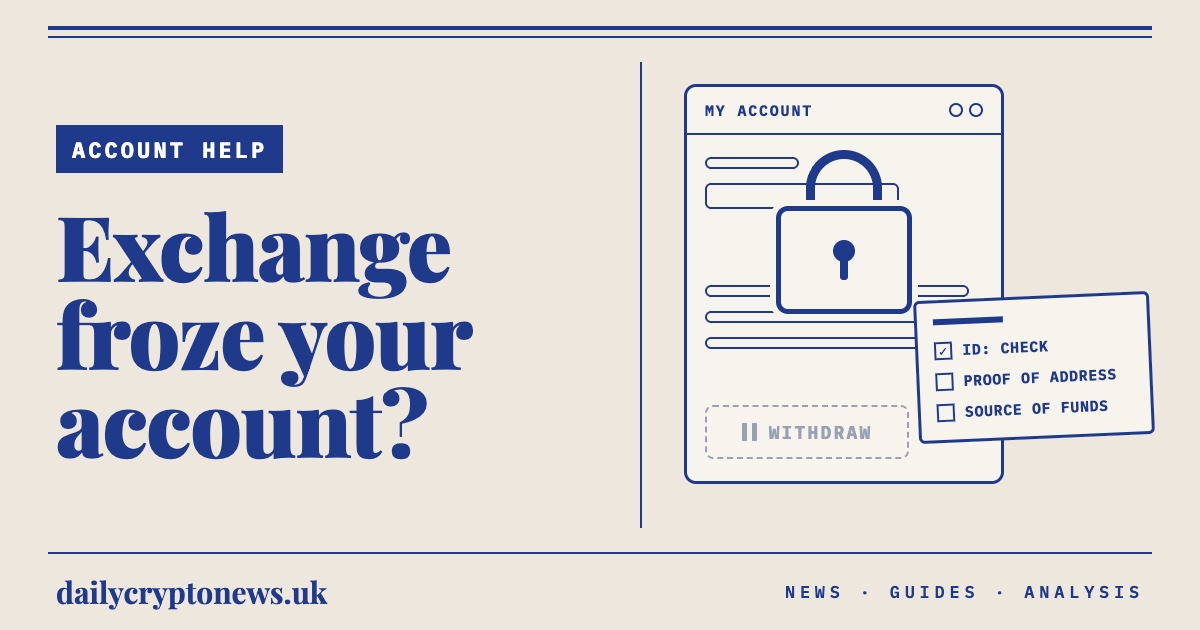
If a crypto exchange has frozen or restricted your account, it's almost always a compliance check rather than a seizure. As of November 2026, UK-registered exchanges must stop dealing with a customer they can't verify, so most restrictions lift once you send the right documents. The harder cases are the ones where the exchange has reported a suspicion and legally can't tell you why.
That second group is rarer, but it explains why support replies can feel so unhelpful. Below is how to tell which situation you're in, what to send, how long it can realistically take and where to complain if nothing moves.
Why do crypto exchanges freeze or restrict accounts?
Usually because a compliance check has been triggered: unfinished or expired ID verification, a payment from a bank account in someone else's name, a card chargeback, a sudden large deposit, or activity linked to a flagged wallet. Under UK money laundering rules, a registered exchange that can't complete its checks must stop transacting with you.
Every crypto exchange registered with the FCA falls under the Money Laundering Regulations 2017. Regulation 31 is the blunt one. If the firm can't apply customer due diligence, it must not carry out transactions with you, and it must end the relationship. The checks aren't a one-off at sign-up, either. Firms monitor accounts on an ongoing basis, so an account that's been fine for three years can be restricted the week you deposit a house deposit's worth of pounds.
The common triggers, roughly in order of how often people describe them:
- Verification gaps. An expired passport, a blurry selfie, a name that doesn't match your bank exactly, or a periodic "refresh your details" request you ignored.
- Third-party payments. Money in from a partner's or a business account. Exchanges generally want deposits from an account in your own name.
- Chargebacks and disputes. Reverse a card payment to an exchange and expect the account to be locked while it's sorted out.
- Unusual activity. Large or fast-moving deposits and withdrawals that don't fit your stated income or purpose.
- Tainted coins. A deposit traced, through blockchain analytics, to a hack, a sanctioned address or a scam.
None of this means you've done anything wrong. A lot of restrictions are automated, and the system can't tell an inheritance from a fraud until someone explains.
Is a restriction the same as having your crypto seized?
No. A restriction or freeze means the exchange has paused what you can do, usually withdrawals, sometimes trading too. Your coins are still recorded as yours on its books. Seizure is different: that needs a court order or a law enforcement power, such as a freezing order under the Proceeds of Crime Act 2002.
This distinction matters, because the panic usually runs ahead of the facts. "Account restricted" on an app screen almost always means a compliance hold. Freezing orders made through the courts exist, but they're the far end of the scale.
There's a separate risk that has nothing to do with compliance: the exchange itself failing. A restriction doesn't make your funds safer or less safe in that sense. If you're worried about the firm rather than your account, our guide to what happens if a crypto exchange goes bust covers that.
Here's how the main situations compare:
| What you see | What's probably happening | Can the exchange tell you why? | Usual way out |
|---|---|---|---|
| "Verify your identity" or "update your details" banner | Routine customer due diligence | Yes | Upload what's asked; often resolved in days |
| Deposit or withdrawal "on hold" after a card or bank payment | Security hold or name mismatch | Usually | Wait out the hold, or fix the payment details |
| Request for source of funds or source of wealth | Enhanced checks on a large or unusual amount | Yes | Payslips, sale records, statements, exchange history |
| Account restricted, support gives only generic replies | Possible internal review or suspicious activity report | Possibly not, by law | Supply documents, complain in writing, wait |
| Account closed and balance "to be returned" | Exchange ending the relationship | Often limited | Withdraw to a verified bank or wallet when offered |
| Court or police notice | Law enforcement freezing order | Through the legal process | Take legal advice |
Why won't the exchange tell you the reason?
Sometimes it legally can't. If staff have reported a suspicion of money laundering, the Proceeds of Crime Act 2002 makes it a criminal offence to "tip off" the customer in a way likely to prejudice an investigation. That's why some replies are vague, even when you've done nothing wrong and the eventual outcome is fine.
Section 333A of the Act covers businesses in the regulated sector, which includes FCA-registered crypto firms. The penalty goes up to two years in prison. So a support agent who knows a report has been made is not going to explain it in a chat window, however politely you ask.
Not every vague reply means a report exists, mind you. Sometimes it's just a support team working from scripts. You can't tell the difference from the outside, which is the frustrating part.
When a report is made and the exchange asks for consent to carry on (a "defence against money laundering" request), section 335 sets the clock. The National Crime Agency has 7 working days to respond. If it refuses, a 31-day moratorium follows, and section 336A lets a court extend that in steps of up to 31 days, to a maximum of 186 extra days. In the worst case that adds up to around seven months. Most restrictions never go near this route, but it explains the cases you read about where nothing happens for months.
What should you send to get your account unrestricted?
Send exactly what the exchange's in-app or email request asks for, through its official help centre. That usually means valid photo ID, recent proof of address, and evidence of where the money came from: payslips, bank statements, property or business sale documents, or records from another exchange.
A few things make a real difference to how fast it goes:
- Answer the actual question. If they ask for source of funds for a £20,000 deposit, a passport scan doesn't help. Show the money's journey: where it came from, into your bank, out to the exchange.
- Make the documents match. Name, address and bank account holder should line up across everything you send. Mismatches are a classic cause of holds.
- Explain in one short paragraph. "This deposit was my share of my late father's estate; the attached solicitor's completion statement shows the payment" beats ten unexplained PDFs.
- Keep a log. Ticket numbers, dates, what you sent. You'll need it if you complain.
If your trouble is at the bank end rather than the exchange (the bank holding a withdrawal of crypto profits, say), the evidence is much the same. Our guide to proving your crypto source of funds goes through it document by document.
One warning, and it's an important one. Search for "account restricted" plus any exchange name and you'll find pages of fake help sites, phone numbers and "recovery agents". Real exchanges don't unlock accounts over WhatsApp or for a fee. Anyone who contacts you first offering to fix a restriction is running a scam, which is how many people end up in the situation we describe in crypto recovery scams. Use the help centre you reach by typing the exchange's address yourself.
How long can a crypto exchange keep your account frozen?
There's no single legal time limit. Routine verification holds often clear within days of sending documents. Where a suspicious activity report is involved, the Proceeds of Crime Act allows a 7 working day notice period, a 31-day moratorium and court extensions up to 186 more days. Account closures can also take weeks.
Honestly, the lack of a clear deadline is the weakest part of the system for customers. Banks face the same rules, but crypto users get less help when it drags on, because most crypto firms are still outside the Financial Ombudsman's reach (more on that below).
My view: if a restriction is about routine ID and you've sent everything asked for, a couple of weeks without a substantive reply is fair grounds for a formal complaint. If support has gone quiet in that vague way described above, keep your complaint factual and patient. Shouting at a firm that may be legally gagged won't speed anything up.
Can you make the exchange show you what it holds about you?
Yes, through a subject access request under UK GDPR. The exchange normally has one month to reply, extendable by two more months for complex requests, and usually can't charge. But it can withhold information where disclosure would be likely to prejudice the prevention or detection of crime.
A subject access request (SAR) is simply a written request for the personal data a firm holds on you. Send it to the exchange's data protection contact, listed in its privacy policy. It can surface things that support won't, such as which of your documents failed checks or notes on why your account was flagged.
Don't expect it to break a tipping-off gag, though. The Data Protection Act 2018 has a crime and taxation exemption (Schedule 2, paragraph 2) that lets firms hold back data where releasing it would be likely to prejudice crime prevention or detection. If the firm refuses or ignores you, you can complain to the Information Commissioner's Office.
Where can you complain if an exchange won't unfreeze your account?
Complain to the exchange in writing first, using its formal complaints process. The Financial Ombudsman Service only covers firms and activities within its remit, and the FCA says plain AML registration doesn't give crypto customers Ombudsman or FSCS protection. That changes for authorised firms under the regime due on 25 October 2027.
That's the uncomfortable part, as of November 2026. Today, most UK crypto exchanges are registered with the FCA for anti-money laundering purposes only. The FCA's own guidance says being registered "does not mean your customers benefit" from the Ombudsman or the FSCS. Some exchanges belong to groups with other regulated permissions (e-money, for instance), and a complaint about those services may fall within the Ombudsman's remit, so it's worth asking the firm directly which applies.
Where the Ombudsman can help, the standard timings are: the firm gets up to 8 weeks to send a final response, and you then have 6 months from that response to refer it. If the firm misses 8 weeks, you can go straight to the Ombudsman. Our explainer on crypto and the Financial Ombudsman covers what changes once firms are authorised.
Frequently asked questions
Why is my crypto account restricted? Usually because a compliance check hasn't been completed: expired or unclear ID, a payment from someone else's account, a chargeback, an unusual deposit, or coins linked to a flagged wallet. UK-registered exchanges must stop transacting with customers they can't verify under the Money Laundering Regulations 2017.
Can a crypto exchange keep my money? A restriction pauses access while checks are done; it isn't the same as taking your funds, which normally needs a legal process such as a court order. If an exchange closes your account, the Money Laundering Regulations allow it to return deposited money, and exchanges usually offer a way to withdraw. Check your user agreement for specifics.
Why won't the exchange tell me why my account is frozen? It may be legally barred. If staff have reported a suspicion of money laundering, section 333A of the Proceeds of Crime Act 2002 makes tipping you off a criminal offence. Vague answers don't prove a report exists, but they're often the reason support can't say more.
How long do crypto account restrictions last? Routine verification holds often clear within days once you send the right documents. Cases involving a suspicious activity report can take much longer: up to 7 working days for the National Crime Agency to respond, a 31-day moratorium, and court extensions of up to 186 more days.
Should I pay someone to unlock my crypto account? No. Restrictions are lifted by the exchange itself, through its official help centre, not through third parties, social media or phone numbers found in search results. People offering paid "account recovery" are almost always scammers. Deal only with the exchange's official help centre.
The practical next step
If your account is restricted right now, open the message inside the app, send exactly what it asks for through the official help centre, and log your ticket number and date. Then make sure the next problem is easier: keep deposits coming from an account in your own name, save evidence whenever large sums move, and don't keep more on any single exchange than you could cope with being stuck for a few weeks. Our self-custody guide explains how to hold coins yourself. This is general information, not legal or financial advice, and crypto is high risk: you could lose everything you put in.
Sources
- legislation.gov.uk: Money Laundering Regulations 2017, regulation 31 (requirement to cease transactions)
- legislation.gov.uk: Proceeds of Crime Act 2002, section 333A (tipping off, regulated sector)
- legislation.gov.uk: Proceeds of Crime Act 2002, Schedule 9 (regulated sector includes cryptoasset exchange and custodian wallet providers)
- legislation.gov.uk: Proceeds of Crime Act 2002, section 335 (notice and moratorium periods)
- legislation.gov.uk: Proceeds of Crime Act 2002, section 336A (court extensions of the moratorium)
- legislation.gov.uk: Data Protection Act 2018, Schedule 2 paragraph 2 (crime and taxation exemption)
- ICO: Right of access, what to consider when responding to a request (one month, extendable by two)
- FCA: Cryptoassets AML/CTF regime (registration does not bring Ombudsman or FSCS protection)
- Financial Ombudsman Service: time limits (8 weeks for the firm, 6 months after a final response)
- FCA Handbook DISP 2.8: Was the complaint referred to the Financial Ombudsman Service in time?
Sam Whitfield
Sam Whitfield is the pen name of the editor of Daily Crypto News UK, who writes and reviews every article on the site.