Why Crypto Apps Make You Wait 24 Hours and Quiz You First: UK Rules Explained
Signed up to a crypto app and been told to come back tomorrow? That's the FCA's 24-hour cooling-off rule, and it comes with a personalised risk warning, an investor category form and a knowledge test. Here's what each step is, what happens if you fail the quiz, and why a bonus offer is a red flag.
By Sam Whitfield, Editor · Published · 9 min read
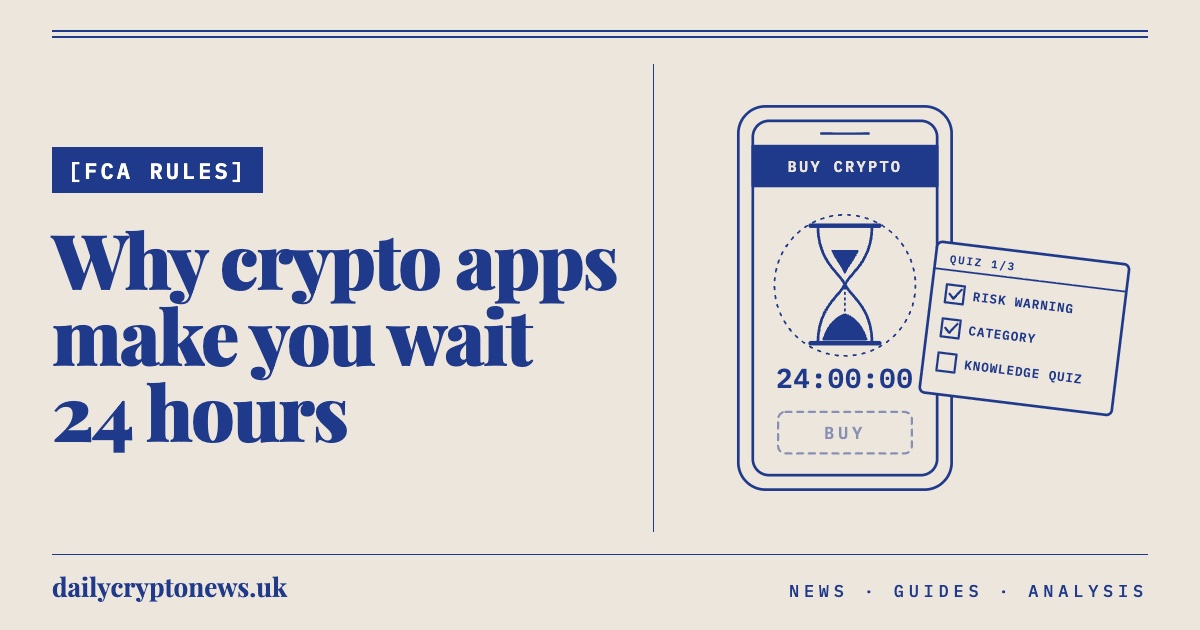
If a crypto app has told you to come back in 24 hours before you can buy, nothing's wrong with your account. It's a UK rule. Since 8 October 2023, firms marketing crypto to UK consumers must give first-time customers a cooling-off period of at least 24 hours, a personalised risk warning, an investor category check and a knowledge test before showing them a "buy" offer.
All of that is still in force as of November 2026. Below is what each step is for, what happens if you fail the test, and why a firm that skips these steps should worry you more than one that makes you wait.
Why does a crypto app make me wait 24 hours before I can buy?
Because the FCA's financial promotion rules require it. A firm must let at least 24 hours pass between you asking to invest and it showing you the actual offer to buy, then ask whether you want to continue or leave. It applies to new customers of that firm, not to every trade.
The rule sits in the FCA Handbook at COBS 4.12A.18. Officially, the thing you're waiting for is a "direct offer financial promotion", which is regulator-speak for the screen where you can actually put money in. Once the 24 hours are up, the firm has to ask you whether you want to carry on or leave, and it has to show both options with equal prominence. No giant green "Continue" button next to a tiny grey "Leave" link.
The point is to slow down impulse buys. In its own words, the FCA says the pause gives consumers time to reflect on the investment and decide whether to go ahead. It arrived in the same package as the ban on "refer a friend" bonuses.
Two things people often get wrong:
- It's per firm, not per trade. COBS 4.12A says the cooling-off and the personalised risk warning don't have to be repeated if you've already received an offer from that same firm. Your hundredth purchase on an app you've used for years shouldn't trigger it. Open an account with a second exchange, though, and you'll usually wait again.
- It's not a cancellation right. The 24 hours happen before you buy. Nothing in these rules lets you undo a purchase once you've made it.
The firm doesn't have to sit idle while you wait, either. The rules say it can carry on with the rest of your onboarding, including the personalised risk warning and gathering the answers for the appropriateness assessment, during the cooling-off period. So other onboarding checks can carry on while the clock runs.
What are the other steps before your first crypto purchase?
There are four "back end" checks: the 24-hour cooling-off, a risk warning addressed to you by name, a declaration of which investor category you fall into, and an appropriateness test of your knowledge. On top of that, any crypto advert must carry a set risk warning, and bonuses for investing are banned.
Here's how they fit together:
| Step | What you'll see | Rule (FCA Handbook) | Can you skip it? |
|---|---|---|---|
| Risk warning on adverts | "Don't invest unless you're prepared to lose all the money you invest..." | COBS 4.12A | No, it's on every promotion |
| Personalised risk warning | Your name, then "this is a high-risk investment. How would you feel if you lost the money you're about to invest?" | COBS 4.12A.20 | Only if you've had an offer from that firm before |
| Cooling-off period | A wait of at least 24 hours, then a choice to continue or leave | COBS 4.12A.18 | Only if you've had an offer from that firm before |
| Investor category | A form saying you're a restricted, high net worth or sophisticated investor | COBS 4.12A.21 | No |
| Appropriateness test | Questions on crypto risks, protections and how the firm works | COBS 4.12A.28 | Not repeated once you've passed for that type of investment at that firm |
| No incentives | No sign-up bonuses, cashback, free coins or refer-a-friend rewards | COBS 4.12A.7 | Not a step, a ban |
The personalised warning is word-for-word in the rules. The firm takes your full name and then shows you that line, with a "Take 2 mins to learn more" link to a plain-English risk summary. It's a bit odd to see your own name in a warning, and that's deliberate. The FCA's own review of firms said behavioural research found personalised messages were the most effective way to get people to actually click through.
What's the restricted investor question about?
Before showing you the offer, the firm must have you declare which category you fit: a restricted investor, a certified high net worth investor or a certified sophisticated investor. For most people starting out, that's restricted investor, which means confirming you won't put more than 10% of your net assets into high-risk investments like crypto.
This is the form that confuses people most. It looks like a box-ticking exercise, but it's asking something useful: is crypto a slice of your money, or most of it?
The FCA's guidance (COBS 4.12A.25) says the 10% figure covers your total across all "restricted mass market investments", the regulator's bucket for higher-risk products sold to the public. Crypto is one of them, but so are things like peer-to-peer lending. Read the wording on the firm's form carefully, because the statement itself spells out what counts.
The high net worth and sophisticated routes have their own conditions, set out in the FCA's statements. Don't tick one just to get through faster. If you're not sure where your own line is, our guide to how much of your portfolio to put in crypto walks through the numbers.
What does the crypto appropriateness test ask?
It checks whether you understand the risks before you're allowed to buy. FCA guidance says it should cover at least 12 topics, including that you can lose everything, that prices are volatile, that hacks or lost keys can wipe out holdings, what happens if the firm fails, and how far the Ombudsman and FSCS protect you.
The list is in COBS 10 Annex 4G. In plain terms, the 12 areas are:
- What the firm does and doesn't do for you, including what checks it does on the coins it lists.
- Your rights, including who legally owns the crypto you buy.
- That you can lose all the money you invest.
- That crypto can be complex and its risks hard to understand.
- That prices can fall as quickly as they rise.
- Operational risks such as cyber-attacks, lost private keys, mixed-up client funds and financial crime.
- What happens to your holdings if the firm goes bust.
- That you may not be able to sell when you want, for example during an outage.
- The firm's regulatory status and what it means.
- How far the Financial Ombudsman Service and FSCS apply (they don't cover poor performance, and the Ombudsman can't usually look at unauthorised firms).
- That crypto isn't comparable to mainstream investments like listed shares.
- Diversification, and the guidance not to put more than 10% of net assets into these investments.
Firms write their own questions, so the wording varies from app to app. The FCA has said questions should test what you actually know, rather than ask whether you think you understand something. If topic 7 makes you nervous, good: our explainer on what happens if a crypto exchange goes bust covers it properly.
What happens if you fail the crypto appropriateness test?
You can't buy through that firm yet. The firm can't tell you which answers you got wrong, and any retest must use different questions. If you fail twice, each further attempt has to wait at least 24 hours. Repeated quick retakes until you pass is something the FCA has criticised.
This part is set out in COBS 4.12A.31 and 4.12A.32. The logic is simple, if a little frustrating. If the app told you which answers were wrong, you'd just change them and pass without learning anything.
The FCA's review of firms, published in 2024, found some apps were letting people retake the test indefinitely, or recycling the same questions with the answers shuffled. It called both poor practice. There's no fixed pass mark in the rules, mind you. Firms decide, but they're expected to treat some wrong answers (say, believing the FSCS covers crypto losses) as a sign of a basic misunderstanding.
My honest take: if you fail, don't just hammer the retry button after the wait. Spend 20 minutes on the topics above. The test is annoying, but the questions are roughly the list of things that go wrong for new crypto buyers.
Why is a crypto bonus or free coin offer a red flag in the UK?
Because offering incentives to invest in crypto is banned for UK retail customers. FCA rules prohibit sign-up bonuses, refer-a-friend rewards, cashback, free gifts and free crypto for investing. A firm dangling one is either breaking the rules or not covered by them, and the FCA says that could mean a scam.
The ban is in COBS 4.12A.7, and the FCA's guidance lists the sort of thing it means: bonuses for investing or referring someone, cashback, volume-linked fee discounts, free gifts such as phones or laptops, and free investments. There's one narrow exception for incentives to transfer an existing holding from one provider to another, as long as it isn't built to get you investing more.
The FCA's consumer site, InvestSmart, puts it bluntly. If you're offered an incentive to invest, the company isn't following the rules, could be illegal, or could be a scam. The same goes for an app that lets you buy within minutes of signing up, with no risk warning and no quiz. It feels smoother, and that's exactly the problem.
Before you sign up anywhere, check the firm is on the FCA register (our guide to spotting a fake crypto exchange shows how). And one thing these rules don't change: plain FCA registration for anti-money laundering still doesn't give you Ombudsman or FSCS cover.
Will these rules change under the new UK crypto regime?
Possibly in the detail. The FCA Handbook already shows future versions of these pages dated 25 October 2027, when the full UK crypto authorisation regime is due to start. As of November 2026, the 24-hour cooling-off, risk warnings, categorisation, appropriateness tests and incentive ban all apply.
The new regime is mostly about how crypto firms are authorised and supervised, and what protections customers get. We cover the timetable in the FCA crypto authorisation gateway explainer. Treat anything in this guide about the onboarding steps as accurate for now, and check back after the FCA publishes its final 2027 rules.
Frequently asked questions
How long is the crypto cooling-off period in the UK? At least 24 hours. It runs from when you ask to see a firm's offer to invest until the firm shows it to you. After that, the firm must ask whether you want to continue or leave. It applies to first-time customers of each firm, not to every purchase.
Do I have to wait 24 hours every time I buy crypto? No. The cooling-off and personalised risk warning only apply the first time you receive an offer to invest from a particular firm. Later purchases on the same app don't trigger a new wait. Signing up to a different exchange usually does.
Can I retake the crypto appropriateness test? Yes, but with limits. The firm can't tell you which answers were wrong, a retest must use different questions, and after a second fail each further attempt has to wait at least 24 hours. Firms also set their own pass standards within FCA guidance.
Is a crypto sign-up bonus legal in the UK? Not for UK retail customers of firms following the FCA's rules. Bonuses for investing, refer-a-friend rewards, cashback and free crypto are banned under COBS 4.12A.7. The FCA says an incentive to invest suggests the company isn't following the rules and could be a scam.
Does the 24-hour cooling-off period let me cancel a crypto purchase? No. The waiting period happens before you're shown the offer to buy, so it gives you time to think rather than a right to reverse a trade. Once you've bought crypto, the price risk is yours.
The practical next step
If you're stuck in the 24-hour wait right now, use it. Finish your ID checks, read the firm's risk summary, and decide your limit before the buy screen appears. If you're starting from scratch, our guide to the best crypto exchanges in the UK compares the platforms you'll be onboarding with. This is general information, not financial advice, and crypto is high risk: you could lose everything you put in.
Sources
- FCA Handbook: COBS 4.12A, promotion of restricted mass market investments (cooling-off, personalised risk warning, categorisation, appropriateness, incentives)
- FCA Handbook: COBS 10 Annex 4G, assessing appropriateness for qualifying cryptoassets
- FCA: PS23/6 Financial promotion rules for cryptoassets
- FCA press release: FCA introduces tough new rules for marketing cryptoassets (8 June 2023)
- FCA: Assessing firms' compliance with 'back end' cryptoasset financial promotions rules
- FCA InvestSmart: Crypto basics (warnings, no free gifts or refer-a-friend bonuses)
Sam Whitfield
Sam Whitfield is the pen name of the editor of Daily Crypto News UK, who writes and reviews every article on the site.