Crypto Influencers in the UK: When a Tip Becomes an Illegal Promotion
Is that TikTok crypto tip legal? In the UK, promoting crypto in the course of business without FCA approval is a criminal offence, and the FCA's test is wider than most creators think. Here's how the rules work, how to check a post, and what HMRC expects from creators paid in cash, gifts or tokens.
By Sam Whitfield, Editor · Published · 10 min read
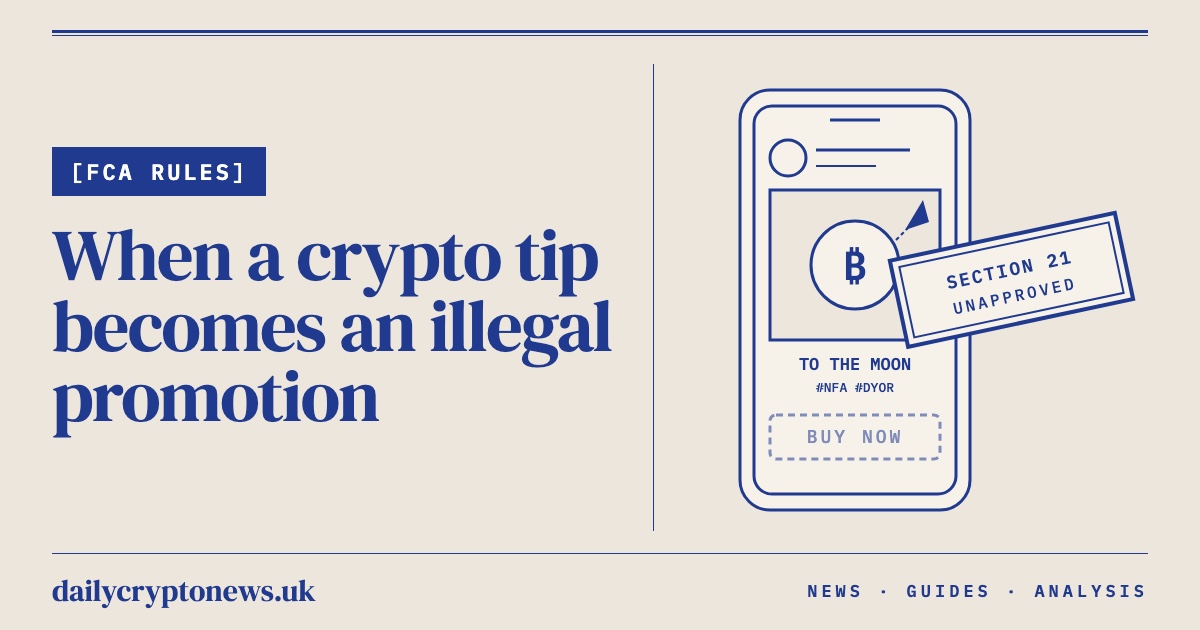
In the UK, a crypto post from an influencer is legal only if it comes from an FCA-authorised firm, has been approved by one, or fits a narrow exemption. If someone promotes crypto "in the course of business" without that, they may be committing a criminal offence under section 21 of the Financial Services and Markets Act 2000, punishable by up to two years in prison, an unlimited fine, or both.
That covers far more people than you'd think. It isn't only the paid celebrity post. Below is how the FCA decides who counts, how to check a crypto tip before you act on it, and what HMRC expects if you're the creator being paid in cash, freebies or tokens.
Is it illegal for influencers to promote crypto in the UK?
Not automatically, but it often is. Since 8 October 2023, crypto promotions aimed at UK consumers have to be communicated or approved by an FCA-authorised firm, made by a crypto business registered with the FCA, or fit an exemption. An influencer posting a coin or an exchange outside those routes is likely making an illegal financial promotion.
The law is short. Section 21 says a person must not, in the course of business, communicate an invitation or inducement to engage in investment activity. The FCA calls this the financial promotion restriction, and crypto was brought inside it in October 2023.
For crypto, the FCA lists four lawful routes:
- The promotion is communicated by an FCA-authorised firm.
- It's made by someone unauthorised (an influencer, say) but approved by an FCA-authorised firm.
- It's communicated by a crypto business registered with the FCA under the Money Laundering Regulations.
- It otherwise fits an exemption in the Financial Promotion Order.
Anything else breaches section 21. The FCA's social media guidance, FG24/1, puts the influencer case plainly: an unauthorised influencer who communicates a financial promotion in the course of business without approval from an appropriate authorised person is likely to be communicating an illegal promotion, unless an exemption applies.
Two details trip people up. The rule reaches posts made from abroad if they're capable of having an effect in the UK, so a Dubai-based account pitching to British followers isn't outside it. And a promotion that's lawful can still break the FCA's conduct rules, for example by burying the risk warning. The FCA treats those as two different problems: illegal versus non-compliant.
Does it count if the influencer isn't paid?
Often, yes. The test is whether there's any commercial interest, not whether a brand sent an invoice. The FCA says hoping for future deals, earning platform ad revenue from views, or chasing followers to charge more later can all be "in the course of business". Friends chatting in the pub aren't caught.
This is where FG24/1 is most useful, because it gives worked examples. In the FCA's view, an influencer would likely be acting in the course of business if they:
- are paid by a firm to post about its services;
- aren't paid yet, but are promoting a firm hoping to land a deal with it;
- promote a firm to pull in views, and the platform pays them for those views;
- promote a firm only to grow followers and likes, so they can ask for higher fees from brands later.
The FCA says the commercial interest "does not necessarily have to be a direct interest" and is meant to "capture any level of commerciality". It also says follower count doesn't matter. A 2,000-follower account can make an illegal promotion just as easily as a 2 million one.
Honestly, I think the breadth is right. The monetised "I'm not being paid for this, I just love this coin" video was always the weak spot, and the FCA's reading closes it. The genuinely private, non-commercial chat is still fine. The guidance says the business test is "intended to exclude genuine non-business communications such as friends talking in the pub."
Can a meme or a Telegram post be a financial promotion?
Yes. The FCA says any form of communication can be a financial promotion if it invites or induces people to invest, including memes and posts in private or invite-only groups such as Discord and Telegram. It singles out memes as particularly common in crypto promotions.
FG24/1 actually prints an example of a crypto meme that it says would be caught by the regime and doesn't comply with the crypto rules in COBS 4.12A. Its point is that people share these without realising they're advertising anything.
The same goes for chatrooms. The guidance says it has seen promotions on Reddit and Telegram "often using memes to hype up specific investments", and that the restriction applies on public and invitation-only platforms alike. If someone runs a paid "signals" group and has a deal with an exchange, the FCA's own example says they'd likely be acting in the course of business, even if they never mention that exchange in the group.
A quick aside on "not financial advice". Plenty of crypto posts end with "NFA" or "DYOR", as if it's a magic spell. Nothing in section 21 treats a disclaimer as an exemption. Whether a post is a promotion depends on what it does, not on the three letters at the bottom.
Has the FCA actually prosecuted finfluencers?
Yes, though the headline cases so far involved forex trading schemes rather than crypto. In February 2026, seven influencers were sentenced at Southwark Crown Court for promoting an unauthorised foreign exchange trading scheme. In April 2026 the FCA led an international week of action that brought a guilty plea and two more prosecutions.
The same law covers crypto, so these cases show how the FCA treats influencers generally. Here's what its own releases and data say:
| Date | What happened | Source |
|---|---|---|
| 2024 (published Feb 2025) | 20 finfluencers interviewed under caution; 38 alerts issued against finfluencer social media accounts | FCA financial promotions data 2024 |
| 20 February 2026 | 7 influencers sentenced for promoting an unauthorised forex scheme: fines from £600 to £3,750 plus costs, and two discharges | FCA press release |
| From 20 April 2026 | Coordinated week of action: 1 guilty plea, criminal proceedings against 2 more people, 4 warning letters, 34 new warning alerts, 120 account takedown requests | FCA press release, 24 April 2026 |
| Same action | 1,267 illegal financial adverts found on Meta platforms, reaching at least 2,338,372 UK accounts; 66% came from firms or people already on the FCA Warning List | FCA press release, 24 April 2026 |
The fines in the February case were small, which surprised some people. Still, all seven had admitted a criminal count of issuing unauthorised financial promotions, and the costs orders were bigger than some of the fines. That isn't a risk a creator should take for a sponsored post.
The FCA's reason for caring is in its own numbers: 62% of 18 to 29-year-olds follow social media influencers, and 74% of them say they trust their advice.
How can you check whether a crypto promotion is legal?
Check who's behind it on the FCA Register, look for the crypto risk warning, and treat any bonus or "free crypto" offer as a red flag. If the firm isn't authorised or registered, or the post looks like a paid push with no label, report it to the FCA.
A five-minute routine before you act on any crypto tip:
- Find the firm. Search the FCA Register for the exchange or token issuer being promoted, and check the FCA Warning List. Our guide to spotting a fake crypto exchange walks through it.
- Look for the warning. Lawful crypto promotions carry the FCA's prescribed risk warning, which starts "Don't invest unless you're prepared to lose all the money you invest". No warning at all is a bad sign.
- Look for the label. The FCA notes that the advertising regulator, the ASA, expects paid or connected content to be "obviously identifiable" as advertising.
- Count the incentives. Refer-a-friend bonuses, cashback and free coins for investing are banned for UK crypto promotions under COBS 4.12A.7. We explain that and the 24-hour wait in our piece on why crypto apps make you wait 24 hours.
- Ask about conflicts. FG24/1 reminds influencers that, under the Market Abuse Regulation, anyone recommending an investment strategy must present it objectively and disclose conflicts of interest. Most crypto tokens sit outside that regulation today, but it's the right test anyway. A creator quietly holding the coin they're pumping is a classic warning sign.
To report, the FCA says: if the firm is authorised, use its "Report a financial promotion or advert" page; if you can't find the firm on the Register, call 0800 111 6768 or use its contact form. If a "celebrity" is pushing crypto in an ad, it may not be them at all; see our guide to deepfake crypto ads.
I'm a creator: what do FCA and HMRC rules mean for me?
Don't post about a specific coin, exchange or crypto product with any commercial angle unless the content has been approved by an FCA-authorised firm or you're sure an exemption applies. And for tax, HMRC counts cash, gifts and services from promoting products as income, and tokens received for a service are taxable too.
On the FCA side, approval isn't a one-off. FG24/1 says firms that approve investment promotions must keep them compliant for their lifetime and get "no material change" attestations every three months. Edit an approved post and you may be back to an unapproved one. The FCA and ASA also publish an infographic for influencers asking, in effect, whether you're the right person to promote a financial product at all.
On the HMRC side, three points from its guidance:
- Gifts count. HMRC says income from creating online content "includes gifts and services you receive from promoting products online". When you're paid in goods or services, you use what they would have cost you to buy.
- The £1,000 threshold. Content income is added to your other trading income. If the total goes over the £1,000 trading allowance for the tax year (6 April to 5 April), you need to tell HMRC.
- Tokens count as well. HMRC's Cryptoassets Manual (CRYPTO21250) says airdrops given "in return for, or in expectation of, a service" are subject to Income Tax, as miscellaneous income or as receipts of an existing trade. Selling those tokens later can also create a Capital Gains Tax bill. Record the token, date, quantity and sterling value when they land.
If a project offers you tokens for posting, you've potentially got both problems at once: an illegal promotion and a tax bill. Our guide to crypto airdrop tax covers the HMRC side in more depth.
Frequently asked questions
Is it illegal to promote crypto on social media in the UK? It can be. Since 8 October 2023, promoting crypto to UK audiences in the course of business is lawful only if an FCA-authorised firm communicates or approves it, a registered crypto business communicates it, or an exemption applies. Otherwise it breaches section 21 of FSMA, a criminal offence.
What is the penalty for an illegal financial promotion in the UK? A breach of section 21 of the Financial Services and Markets Act 2000 is punishable by up to two years in prison, an unlimited fine, or both. In February 2026, seven influencers who promoted a forex scheme received fines of £600 to £3,750 plus costs, or discharges.
Does posting "not financial advice" make a crypto post legal? No. The FCA's guidance looks at whether a post invites or encourages people to invest and whether the poster has a commercial interest. A disclaimer such as "NFA" or "DYOR" isn't an exemption under section 21.
How do I report a crypto influencer to the FCA? Check the firm being promoted on the FCA Register. If it's authorised, use the FCA's "Report a financial promotion or advert" page. If you can't find it on the Register, call the FCA on 0800 111 6768 or use its online contact form.
Do influencers pay tax on free crypto or gifts from brands? Yes, potentially. HMRC says gifts and services received for promoting products count as income, and tokens received in return for a service are subject to Income Tax. If total trading income goes over the £1,000 trading allowance in a tax year, you need to tell HMRC.
The practical next step
Next time a creator you follow pushes a coin, spend two minutes on the FCA Register before you spend anything else. If the firm isn't there, or the post has no warning and a bonus attached, scroll past and report it. For more on how hype-driven tokens work and the tax that follows, read our guide to memecoins, UK law and tax. This is general information, not financial or tax advice, and crypto is high risk: you could lose everything you put in.
Sources
- FCA: FG24/1 Finalised guidance on financial promotions on social media (26 March 2024)
- FCA: Cryptoasset firms marketing to UK consumers (the four routes and the section 21 offence)
- FCA press release: Influencers fined for issuing unauthorised financial promotions (20 February 2026)
- FCA press release: FCA spearheads global action to stop illegal finfluencers (24 April 2026)
- FCA: Financial promotions data 2024
- FCA: Misleading financial promotions (how to check and report)
- HMRC: Check if you need to tell HMRC about your income from online platforms
- HMRC Cryptoassets Manual: CRYPTO21250, Income Tax on airdrops
- HMRC: Check if you need to pay tax when you receive cryptoassets
Sam Whitfield
Sam Whitfield is the pen name of the editor of Daily Crypto News UK, who writes and reviews every article on the site.